Friday, July 19, 2013

Urban fabric and noise: the art and science of being considerate

Our urban fabric is woven from mutual respect we have for one another. If not respect at least we understand there are conventions of self-restraint that we adopt in order not to impose on one another's space. The urban space is crowded so in general, these conventions are carefully observed. We try to be considerate. 

In the case of urban noise the boundaries are less established. What is the source of noise? How to control it from spilling into other peoples' space? Noise isn't something you can keep to yourself.  Here the urban fabric may falter. Recently the New York Times published a series on urban noise. The sources of noise are often far from the "recipients." In a word, hard or impossible to control. There's not much you can do about noise that is generated from a distance. For close neighbors, the only solution may be restraint and consideration. "Neighborliness." Is it too much to ask?

Here in Cambridge we have a dense urban fabric and in some cases, like in the big city, noise is hard to find and control. In other cases it's easy. We live in a small space with two other households immediately in front of us. On all sides there are lots more households. We have a small green space that we maintain as a lush and generous garden, somewhere we can cool off and enjoy the flowers, something everyone can enjoy even though it "belongs" to us. 

One neighbor's wall, unfortunately windowless, faces our open space, which we share with the two families in front. The outdated in-wall air conditioners spew their clatter whenever the temperatures warm up. Some days they're roaring at dawn, when it's cool, in the otherwise peaceful moments of the morning. It's a shame, because if we want to catch a breeze outside we also have to catch a few unwanted decibels of mechanical clatter. 

Living together in the city is an art and a science. It's an experiment in mutual constraint, an opportunity to develop respect, or at least consideration, for other people who live close by. A bit of a challenge as temperatures approach 100, but maybe worth a try. 

Thursday, July 11, 2013

Cognitive Bargain

"A well-designed object or experience is a cognitive bargain with unusually high return-on-use." These words of John Maeda resonate with me, perhaps because I've been thinking about design most of my life. As luck would have it, or maybe because I'm aware of design, I feel like I've spent most of my time immersed in a world of designed things. As a botanist and gardener I'm shoulder-high in the wonders of plant form. As a cook I get to handle kitchen implements, throw pots around, and make seltzer from my wonderful "sodastream"--a cognitive bargain if ever there was one (thank you Ben and Molly!).

Somehow the built environment, the urban landscape, the local "lay-of-the-land" are always high on my radar, I guess because I'm always out there on my bike. In my neighborhood there's one place I keep going back to, the magnificent Northpoint development in East Cambridge. More important than the buildings, the position of Northpoint is its strongest asset. Steps away from the scruffy Lechemere T stop, on top of the great dynamic waterways of Boston, and spitting distance from the roar of bridges and highway, Northpoint sits like a gem in the setting of the city. 

Its planners tried, and to an extent succeeded, in bringing nature into this place, high berms with lawn and birch trees, weedy sun drenched prairies, and stretches of wetland, looking less artificial as the months and years pass. The other day I was over at Northpoint on a quiet hot morning and for the first time I saw the culverts they devised as part of the wetlands. Normally I suppose you wouldn't notice them. But these days, because I'm so busy writing grant proposals to get me back to Sri Lanka, where I want to study their ancient engineered irrigation systems, the culverts stood out. 

Nothing that super special about them I guess, but the designers dressed them with heavy stones, gave each one a bit of personality, and imbued the site with just that certain touch of design gravitas. Incidentally the culverts resemble the ancient massive stone anicuts, invented by the Sri Lankans about 1500 years before Europeans learned to make them. A long-lasting cognitive/ecological "bargain" that well befits John's description of good design. 


Saturday, July 6, 2013

Wildland-Urban Interface

Earlier this week 19 firefighters were killed trying to protect the real estate of people who decided they could build McMansions in the wilderness. Boy am I mad. In today's Washington Post there was a column by a firefighter and geography professor who said, "no one should die to save a house." I agree with her. Why should anyone sacrifice to save a few houses that were selfishly, expensively, unsustainability plopped down in the wilderness?

Here in civilization we do things a little bit differently. We are working on solutions that combine quality, dense housing with urban/natural landscapes.  In the process we are rehabilitating huge tracts of land that were abused in the making of our cities. We are working to provide a just environment where everyone has access to resources like housing, nature, healthcare, and oh...by the way...voting rights.


Monday, June 24, 2013

Art as a gateway to scientific inquiry

Did I tell you how frustrated I was when I started to do ceramic sculpture? My "problem" is that I loved tiles. I couldn't think past the goal of developing new designs for flat things. And I made some pretty nice flat things. Flat things that curved, and flat things that bent, and flat things you could see through. I started to build new flat things on top of the fired flat things I had built. I brought my friend and colleague Lynne Allen into the drying room one day. Lynne is a printmaker and I asked her "isn't this the kind of way of making prints?" Don't get me wrong. I'm not bragging or anything but I think I invented the 3-D printer. 

I had a hard time getting past the flat things. Partly because I loved them and partly because I literally couldn't wrap my head around doing anything else. I didn't want to make "pots" because I knew that what I wanted to do was create some kind of sculptural objects. The problem of three dimensions was a real killer.

As an artist in his 50s at the time it looked and felt to me like my brain wasn't flexible enough to think in 3-D. And then one day after a trip to Mexico visiting some incredible ruins in the Yucatán, I figured out a way to make columns like the ones I had seen at Ake. True I struggled with that as well. But I woke up one morning and I realized that I had gone beyond the broad, broad flat canvas around to the other side. I was working in 3D. 

So what does this have to do with scientific inquiry? Sometimes we struggle with ideas, problem, or puzzles that just seem impossible to solve. I've realized for a long time that my students have a really hard time with what I teach, for a lot of reasons. For me, playing and playing with the clay "freed" my mind. The play let my hands and heart do the thinking while my mind relaxed. After all how "important" was it to work in 3D. I have my day job as a tenured professor. 

But I think opening your mind, or our students' minds, or both, is a great way to go, a super benefit of letting loose and considering things from a whole different perspective. Art? Science? Ways of thinking, ways of experimenting, ways of problem solving. Let's try some more parallel play and see where it goes!

Wednesday, June 19, 2013

Permeability: Just for Cell Membranes?

What is permeability? What does it mean when something is permeable? What do we mean when we say something has permeated something else? In class we discuss the semi-permeable cell membrane in detail, but we never really discuss the concept of permeability. It seems that the idea of permeability has to do with the movement of one substance across a boundary, but that is a very general and perhaps incomplete concept. What is a boundary? What is the substance? Does permeability have only to do with size? Porosity? Chemistry? Can we think of permeability in other ways? In common language we use the term permeable in many contexts. For example, we say that people in love are permeated with attraction for one another. Can permeability also relate to vulnerability? In another context we may say that a product has "permeated" the market. Does this imply strength?

As a scientist and an artist I think there are many ways to look at concepts we might otherwise take for granted. We can learn a lot this way. And by exploring "scientific" concepts from different angles, perhaps we can understand more about the properties, propensities, and possibilities of our world.

Here's an example. In this experiment with ceramics I made large balls of newspaper, then covered them with ceramic slip impregnated with salt. I "glued" the balls together with more goopy clay. Once my sculpture was dry I stuck it in the kiln and baked it for a couple of days. Fortunately or unfortunately, depending on how you look at it, the thing broke apart as I pulled it out of the kiln. But I got to learn a lot about the behavior of my materials.


Look closely at the mess I made and you can see that this is actually an experiment in permeability! How effectively did the slip permeate the newspaper? The thin paper-like formations are actually ceramic "paper," so you can say the permeability of clay slip into paper was pretty effective. Now look at the purple-blue color. That's the salt, vaporized in the heat of the kiln and able to then permeate the almost-molten clay. What do we see here? The salt did not penetrate the whole structure. Reasons unknown. But we have learned more about permeability. To be a bit more "scientific" we have learned something of how a vapor permeates a semi-solid substance in the oxidizing environment of a high temperature kiln.


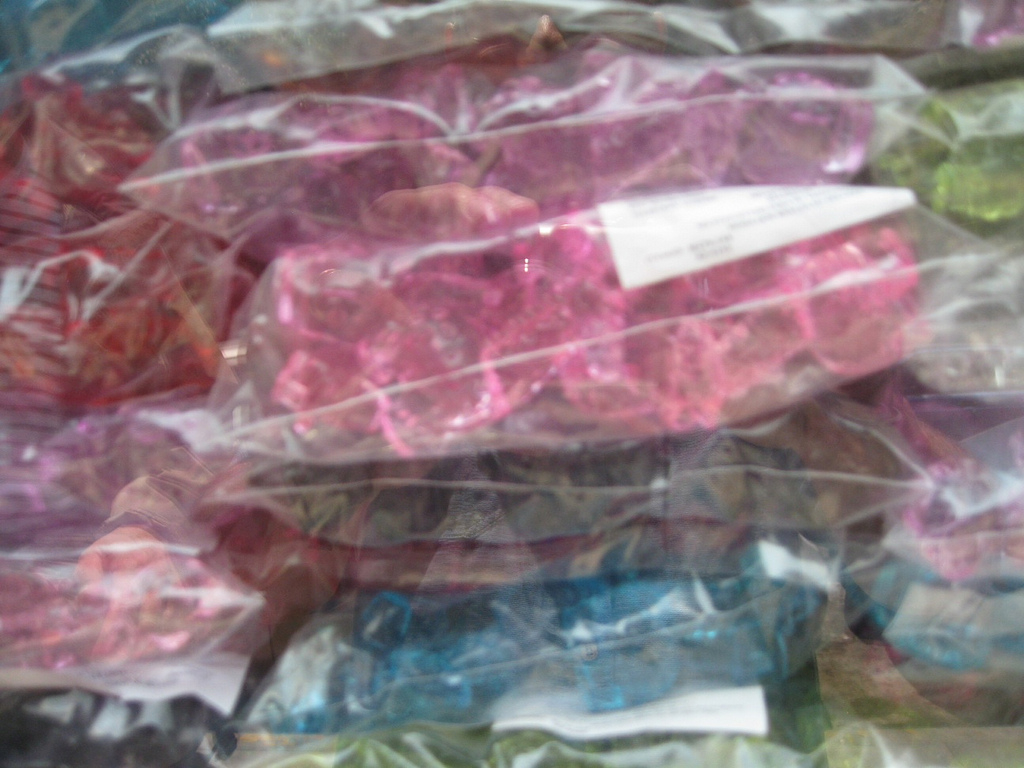
My next example is from a store window in the incredible Centro Historico of Mexico City. I took this picture when I was preparing for an art residency there, which was supposed to focus on movement and materials of this vibrant market district. Pictured here are bags of plastic objects. The objects themselves are permeated with color. The plastic bags block some of that color and the window glass blocks it more. The lens of my camera blocked more of the color, as did the air between the window and my camera. We could go on. But here the question of permeability arises again. How "permeated" with color is this photo? And how "permeated" with color were the original plastic objects? You can see that in this example we are discussing permeability in a context that is different from my ceramics experiment.


I think we could go on about questions of permeability all day. Probably there have been lots of books written about it. From philosophy to thermodynamics, permeability is a huge question. I like to stay somewhere in between, in the world of biology. I also like to keep my blog posts short. So take a look (or should I say take a sniff) at the photo below. Lilacs. Beautiful luscious harbingers of spring, fragrant, delicious, rich appealing aroma. They permeate the atmosphere with their visual and olfactory generosity. Who says science and art are miles apart?


Tuesday, June 18, 2013

Plenty city

I struggled all winter with the horrible climate of Boston, seriously thinking about moving to a warmer place. Hated that I had to stay in the house. Mostly it was true because the cold weather has begun to physically hurt me.

Even as spring progressed, now diving into summer, uncomfortable to get on a bike most days. Rain, cold breezes, the prospect of never ending suburbs as my prime destination, all kept me off my bike. Today with only 60% chance of severe thunderstorms I decided, "it's now or never! "

I got on the bike and rode along the Charles River. I had the bike path almost to myself. Abounding nature, sun flecked woods, brilliant open fields dotted with flowers, and vistas across the river were my reward. I found ripe mulberries and ate them right off the tree. The shaded paths were redolent with aromas of the riparian environment, still damp and puddled from yesterday's storms.

At a certain sunny bend in Allston I felt the eastern breeze. Harsh and cold earlier in the spring it put up a benign caress today. But why was it there? I turned around to see a bank of dark clouds to the north and west, the promised cold front swallowing up the atmosphere and sucking in ocean air off the coast. Whatever. I needed a moment to write down these impressions on a bench by the river. I'll get home before it pours.


Saturday, June 15, 2013

Water feature

The water feature in our garden is a large ceramic container that I lug in every winter and bring out again in the spring. Last week when it looked like it might finally warm up I filled it with water and got a couple of floating plants. Water lettuce and water Hyacinth do well in the bright morning sun and afternoon shade. They also have extensive underground rhizine systems that provide plenty of habitat.

After I had plants floating in the water for a few days I noticed that the container was full of mosquito larvae. I rode my bike quickly to the local pet store and bought 80 cents worth of minnows and black goldfish. The larvae were gone in two days.

Now the fish patrol the water for whatever falls in. Sometimes I see them break the surface as they capture something. As much as I love the plants in my garden the most intriguing and peaceful spot seems to be next to the water. Here I sit on the front step on a rare warm morning looking into transparent water filled with shadows and movement.