Wednesday, March 14, 2012

Interdisciplinary

One of my sabbatical goals is to bridge the gap between science and the humanities. I am finding my sculptural work to be a great way to link various disciplines together. Yesterday I saw my friend and colleague Ian Taberner at the Boston Architectural College. I asked him a couple of random questions about how architecture connects with some of the sculpture ideas that have emerged for me in the past few weeks.

Dancing Piece

It was kind of scary to hear him say many of the things I've been writing about "letting go" in the creative realm of things. Certainly while architecture depends on a highly controlled process there are many junctures at which its creative process shows universal connections with the things I've been writing about.

 Dancing Piece

Ian is a great teacher and it was a good conversation because it got us both to reflect on teaching and learning, creating and contemplating, and the question of process and control in both our work. Having a chance to communicate with someone else on these topics was a nice end to the day.

Home Made Glaze Moment

Tuesday, March 13, 2012

Extending the Body

The other day Batu asked me why I hadn't been around the claylab recently. Actually our paths have just crossed because I've been doing a bit of work around there, just not when he's around.

I told him I've had a lot of interesting thoughts about sculpture and he laughed in his characteristic way, "Yes, that's an existential question!" I've posted here before about the existential connection to clay...

http://scientistartist.blogspot.com/2012/02/existential-question.html

...but to my amazement the question keeps growing. Here's the latest iteration. It goes back to the realization that clay sculpture is an extension of my heart, hands, and brain. Fair enough.

Also fair game is that I've written that I work in a "consciously unconscious" way, which is not necessarily within the "normal" boundaries of making art.

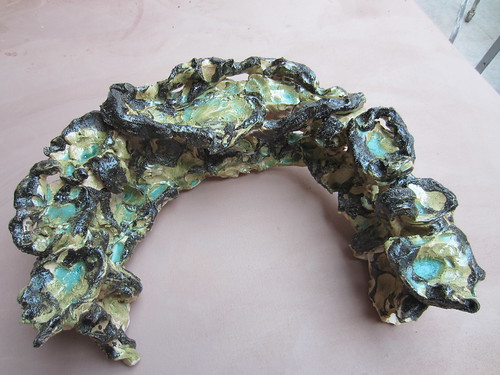
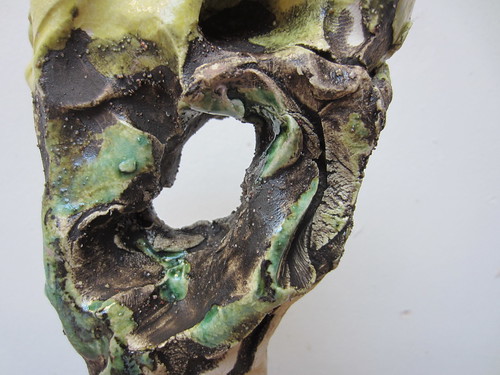
But the new twist is that pieces have been coming out of the kiln looking like body parts! I've had a couple of years of dental problems and I put in a night guard every night to keep me from grinding my teeth. I won't show you a picture of the night guard here (it's kind of gross) but have a look at this piece I just brought home. It's uncanny how much it looks like the night guard or alternatively, the jaw.

Sculpture from Above

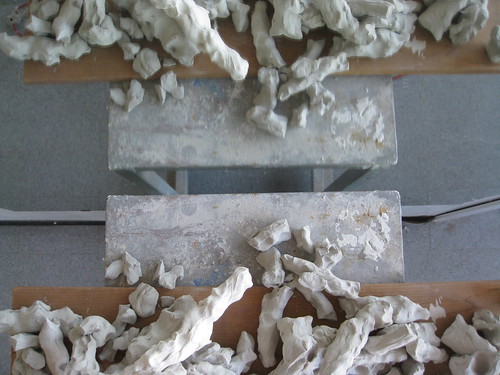
My project "The First Billion Years" involves preparing a thousand pieces, each of which represents a million years of evolutionary time. I didn't make these to look like anything but the one pictured below bears an uncanny resemblance to a hand!

Lineup for the First Billion Years

All this ties in I think with questions of problem solving--feeling your way through a problem in the kinesthetic environment of the claylab. So maybe it's a good thing I didn't run into Batu or anyone else. Time to think deeply about existential nature of clay sculpture.

Monday, March 12, 2012

Interpreting Movement in Art and Life: Reflections on Universal Themes

Movement can be anything. Flow, growth, development. It can be non-physical or minimally physical like the forward movement of time or musical notes that slide from one to the next.


Poking around the Museum of Fine Arts in Boston this morning I spent some time with the Renaissance paintings. Looking closely at them inspired me focus on flow and reflect on flow in my clay sculpture.

Meanders

So many of the paintings depict flow, whether it's flowing clouds, flowing movement of human bodies, or in a more abstract sense flowing lines, textures, and shades. I had just come from clay lab (it's my spring break and 70 degrees so I decided to treat myself to the luxury of doing and looking at art) and looking at all this "flow" gave me pause. Hadn't I just been working on a couple of clay sculptures, trying to emphasize a sense of movement in each one?

Prairie Storm Clouds

This wasn't any kind of an attempt to copy the Renaissance masters! Far from it. In clay lab I was just trying to keep the pieces "alive" by accentuating flow. Really I was just helping the clay do one of the things it does best.

Part of my Show

All this thinking got me hungry. But it also got me to thinking. In addition to literal "flow" that we can observe or measure, isn't there also a "flow" of aesthetic sensibility both inside and outside the arts? In a narrow sense I could be talking about "art history" and in a broader sense, maybe this is a discussion about cultural trends that move along through the generations.

Mexico Rocks

I wish I had an answer. As a cultural anthropologist I assume maybe there are certain "universal" aesthetic appeals. For example a line or a shape that persists in an 11th century statue of a Buddah, a Renaissance painting, or a wooden bow of Northeast woodland native Americans.

Chichen Itza Roundel

It would be interesting to follow this idea more to see where it leads. Can it help us take apart problems that look specific but carry universal themes?

Strange fish


Saturday, March 10, 2012

Learning the Hard Way

The title "Learning the Hard Way" sounds strange. Is there any other way to learn?

Failure and Success

So many pieces broken on their way to the kiln. So many botched glaze jobs. Once a student told me to straighten up when I walked around the studio. I laughed out loud because when I'm there I'm deep in thought. Maybe that puts a scowl on my face but I'm smiling inside.

Structure Full of Shards

As a scientist all of my work is experimental. That statement is easy to make but expensive to live up to. The time and hope you put into a piece may not pay off. But it might.

Two Porcelain Bricks

At Medicine Hat, many of my fellow ceramicists took assiduous notes on the glazes and underglazes they were using. Maybe they were right. Finding just the perfect finish could be replicated and put into production.

Surface Moment

Platter of Asterisks

Ceramic Ringtone Transmogrifier

Either I was too lazy or too impatient to do anything like that. I just wanted to keep making art and seeing what worked, evaluating the results and noting winning combinations in my head.

Friday, March 9, 2012

Invention and Convention

Creative people are in a constant flux between invention and convention. Invention drives us. Convention holds us. Invention is original. Convention is inherited. Invention grows from you. Convention is chosen. Neither of these states is absolute, but neither of them seems to have boundaries either. Can you go too far in one direction or the other?

Sculpture

To earn my PhD in Evolutionary Biology from Harvard I had to cleave close to convention. As a taxonomist, scientific convention was my metier. Studying old species names, old species concepts, old texts, all required me to bathe in and wrap myself in convention. Publishing, teaching, and gaining tenure also required following a series of conventional practices. Obviously, there were rewards for these behaviors.

Invention and Convention

As I grew as a scientist I found myself bucking many of the conventions I had chosen (or was forced, depending how you look at it) to adopt. My research was strictly scientific but my ideas were unconventional. I developed an inventive way to look at natural form based on what the natural form "told" me. As I studied microscopic shapes I came to learn how they developed by careful observation. Exploring further, the inventive method I developed led to some startling questions that lay way outside of the dogma of my field. As is often the case in science (and I don't understand why this still comes as a surprise), the community of practitioners accepted the ideas reluctantly at best.

Invention and Convention

Invention and Convention

As a self-taught artist my sculpture practice is outside of convention. I can't claim to be an "outsider" artist because I am deeply steeped in the aesthetics of art, a knowledge tempered by historical understanding and knowledge of the natural world. I am, however, unfettered in the way I can approach my work. And the consequences (acceptance or non-acceptance by the community) are relatively unimportant. My career is not threatened either way. I feel that my art has gone further than "art for its own sake" because working with clay has led to understandings that involve but transcend art. For example "problem solving" has little to do with "composition." Or does it?

Sculpture from Above

In any case I feel that by experiencing invention in my art practice I can follow whatever path I want. What lies open to me seems to be limited only by my own perceptions.

Sometimes when I look back at my professional life I wonder whether I adopted convention to too great an extent. Whether a more fully acknowledged "invention" outlook might not have served me better. I would certainly recommend invention for people who thrive with it. There are consequences but there are rewards as well.


The Haptic Learning Environment: Getting the Feel for an Idea

Touching the material gives us a window of understanding because it engages another part of us. Like smelling, touching is one of those senses that we aren't so aware of. Consequently, we don't use it enough.

 Dormancy

Haptic learning, kinesthetic learning, tactile learning. All of these things are more or less the same. All of them engage touch.

  Dormancy

Open a new sense, focus with new perception, find a new way to solve a problem.

Dormancy

Working with clay is the best opportunity I know for getting a feel for an idea. The clay in process, the object that results, the actions involved in the making, all of these are part of an idea.


Thursday, March 8, 2012

Body Awareness: Can You Touch an Idea?

In yesterday's post I played around with thinking about blank spaces and how we can solve problems from lots of angles.

Mimosa pudica

I started to think about when I first started doing ceramics, before I understood it would lead to sculpture. My teacher that semester, my friend and colleague Sachi Akiyama, was working furiously to get some of her large sculptures finished for a show. Her stuff is cool.

http://sachikoakiyama.com/

Sachi told me something I never thought of before: Doing sculpture develops body awareness.

What did she mean? I interpreted her statement to mean that one's interaction with the medium (she does larger-than life sculptures from wood) requires an awareness. Of the hands, the shoulders, the torso, even the legs. If you are involved with your sculpture you understand it in relation to your own body.

Moment

I've written about this before in terms of thinking that sculpture is an extension of your heart, brain, and hands. But I think there's something else there.

When you are playing with the clay you are solving clay problems. The clay wants to behave like clay. You want it to do your thing.

Cleaning Kiln Shelves

While you're trying to get the clay to behave you are devoting thought, energy, and action to the material. So you are solving the problem with your body.

Solving a problem with one's body....sounds strange. By physically engaging the clay, can we say we are "physically engaging" a problem? By extension, can we say that we are engaging ideas with our body?

Sphinx Moth and Viburnum
I think yes. And if solving clay problems with your physical body is possible, touching an idea is not far off.

Ancient Assyrian pollinator