Wednesday, July 4, 2012

Landscapes and Cognition

The past few weeks I've been on the road with a summer institute from the National Endowment for the Humanities in a study of cultural connections between Mesoamerica and the desert Southwest of the United States. What an amazing trip it's been.

Huge Mexico City Demonstration

As the lone scientist with a group of art historians, archeologists, sociologists, anthropologists, historians, and assorted others, I've had a unique chance to observe the workings of scholars in a range of disciplines. Also, I've had the chance to see just where crossovers lie, and where disciplines seem to draw the line at interdisciplinary thinking.

Tape Store


The sort of glue that's holding us all together is a wonderful set of visiting scholars who have introduced us to concepts as wide ranging as mesoamerican iconography, Hopi kinship practices, and the geography of traditional ball courts. Our scholars have travelled extensively with us for on-site interpretive sessions, meals, and conversation.

My NEH Posse

One element that has come through strongly for me is the concept that people in many traditional societies have placed value on their landscape as a source of spirituality and history. Migrations, pilgrimages, and seasonal movements through the landscape all contribute to a sense of physical surroundings as culturally meaningful phenomena.

Continent

Coming hot on the end of a trip to Yellowstone a few weeks ago it occurred to me that in the United States we have also created a sort of "sacred" landscape in the form of our National Parks. A fitting thought for the 4th of July perhaps, but one that is not meant to underestimate the brutal realities of European settlement of this continent.

A trip to the Grand Canyon earlier this week taught us the story of the Hopi emergence, something that occurred right in the center of one of "our" national shrines.

Theres so much to write on this and related topics. But I don't want to spend whole pages on it, at least not for now. But to head back to Mexico City however briefly, massive, peaceful student demonstrations on the Zocalo reminded me of the power of collective perceptions of place and time.

Massive Demonstration

More to follow, soon I hope, on space, time, and human cognition. Of course, lots of thoughts on art and science to follow too, I promise.

Tuesday, June 26, 2012

Why do People Make Art?

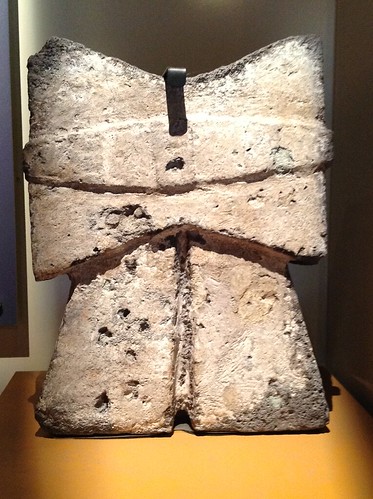
Wandering around the Museum of the Templo Mayor in the ancient sacred precincts of Mexico City I came upon a stone sculpture that got me wondering about a million things. It is one of the strangest prices I have ever seen and I doubt I'll ever get to the bottom of its mystery.

The sculpture was found in the ruins of the Templo Mayor, the great sacrificial temple of the ancient Aztecs in Tenochtitlan, the capital of the Aztecs. It depicts a paper bow that was wrapped around priests as part of their costume. The bow, or perhaps the paper, was meant to invoke rain, part of the elaborated and complex ceremonial activities in the Templo Mayor.

Whatever its purpose or efficacy, the bow was considered an important component of ritual. What occurred to me as remarkable is that this ephemeral object would have been reproduced in a massive stone sculpture.

Why do People Make Art?


Gorgeous, sensuous, and powerful, the stone sits today in the Museo del Templo Mayor. But why depict a piece of paper in stone? Can ws assume that the stone was meant to carry the same ritual power as the paper? Was the stone object made as a reminiscence, a symbol, an evocation of ancient village rituals that were later brought to the Capital? Might the stone have acted in some other ritual capacity? Was it connected to ritual at all? How do we make this assumption? 

 During a later trip to Mexico City, I came upon another exhibit at the museum. This time, a ritual paper figure was on display. It had been unearthed quite recently, and it seemed to provide an answer to my initial questions about the stone "bow." This object closely resembled contemporary paper objects that are used in remote Mexican villages to this day. They are part of a complicated ritual that involves sacrifice (of turkeys), spreading of the animals' blood, a long overnight pilgrimage to a holy site, and days and nights of ritual back in the village. 


This massive never ending game of paper scissors stone got me to wondering, why do people make art in the first place? If the paper bow was a piece of ephermeral ritual performance imbued with movement and moment, what inspired an artist to record it in massive, unchanging, and permanent stone?

Wherever we travel around this amazing place, Mexico City, the question never stops bothering me. What is art and why do we make it? What is the moment of spark or inspiration or motivation that awakens in our consciousness and in our hands? What are the things we decide to represent and why?


Thursday, May 31, 2012

What's Real and What's Not?

Wandering through the MFA yesterday it's apparent over and over why the root of the word museum is muse. Always it seems there is something to think about there.

Complex Ant Hill

I got to pondering about an old question while I was there. "What's real and what's not?" Seems like kind of a junior high- or high school-age kind of question and it surprised me to find myself in the middle of this thought at my advanced age!

Twin Ant Hills

Depending on the day, there is art that delights and art that frustrates. Art that soothes and art that angers. Art that engages and art that you can't stand to spend a second on. Art endeavors that seem "real" and those that seem like "fakes." Maybe it's the fact that art is a human construct. We may accept or reject what the artist has constructed because it rings "true" or not in our own eyes. I can't quantify it but if you have spent a long time looking at art you may know what I mean. And you may agree that it depends on your mood. But there do seem to be trends. Some stuff is worth looking at and some isn't.

Close to the Ant Hill

I wonder about this in terms of my own art practice too. I know what I want to accomplish and I know what I want to "get" out of doing art. Considering construct, it's very much a person one. But why not continue along with what seems authentic to me? Acknowledging all the while that "authenticity" is a subjective concept.

Ant Hill Hay

This may in a sense hold the key to why I went into science. Looking at a rock, a stream, a flower, a lichen, or a leaf is real. Ant hills, like the pictures I'm showing here today, are real. They are constructs, similar in some way to human constructs but in other ways, quite different. They are the interaction between insects and their physical environment, insects and their community, a product of evolution. Yes, evolution icludes mimicry and camouflage and so on, but there's no fakery. The natural world, animate or inanimate, is present as a fact. So after many years of considering and seeking what I'll call "authenticity" in my own life, the chance to look at and analyze nature once I moved to Alaska, and the opportunity to pursue the study of nature that came later seemed like an almost flawless way to stay on track with what's real.

Ant Hillls

Later of course I found out that in the practice of science, and in the broader academic community, there's lots of posing, posturing, herd instinct, self-promotion, and, well, fakery. Not that it's all that way, but there's plenty of it.

Closeup Ant Hill

So I guess similarly as I walk through the halls of a great museum I can muse on what strikes me as authentic vs. inauthentic. Where human endeavor is concerned there's room for both.

A Mountainous Landscape

Wednesday, May 23, 2012

Still Thinking About Motion

Still thinking about how we can translate motion into visual art. Sculpture, video, and plant growth...how do these all fit together? How do we circumscribe the ideas behind "new media?" What (if any) is the relationship between naturally-derived movement, mechanical movement, and electronic movement?

Growing Sculpture Detail


Tuesday, May 22, 2012

Coming Up With New Ideas and Finding the Right Space

My little experiment with applying for artist residencies has borne some results. Mostly it seems that 1) there's enormous competition and 2) even for "emerging" artists there is a certain tenor to my work that doesn't "fit in." What do I mean by that?

I think there is a certain polish, a self-consciousness, a certain tone of presentation maybe rooted in fine arts training, that distinguishes "real" fine arts people from me. I don't say this to be harsh with myself at all. I think my work is hard to categorize and I probably don't "fit" into any "category" at all.

Troops

I look at this as a good thing. Applying and getting so many rejections has helped me hone my ideas about what I want to be doing during this sabbatical. Unquestioned through it all is that I still want to be doing art.

Background

How to fit that "art" into some kind of space, and does it even need to be there? The big, direct answer is no. I could do my work in a vacuum. But I think I am happier doing it in a context. And there are many contexts I can fit into.

"Shy"

Both of the fellowships/residencies I've been accepted to this summer involve some sort of interdisciplinary "bridging" of gaps. As a matter of fact this is what I set out to do in my formal sabbatical proposal, so these opportunities are a great fit.

Ceramic Rope

More than that, the work I seek to do is something that hasn't been invented yet. I like that challenge, however it happens to play out. And I look forward to a year of discovery, growth, and change that lead to many more years of mindful, productive, and positive evolution.

At Rest in the Garden

Monday, May 21, 2012

Motion as a Sculptural Element

Still playing with ideas of motion as a way to inform sculpture. With water, the more it seems to move the more it stands still. Its interplay with light suggests a mutual effect each has on the other.


Water making forms of its own, water fitting in and flouting forms, water in contact with rock. All of these result in patterns at once recognizable and dazzling in their variability.


Considering "static" art: How to engage your hand in creating a reflection of movement? Is even suggesting movement desirable? Or is there another level, another dimension almost, at which we want to inhabit the triumphal world of motion?


Motion temporal and spatial, two properties or one? And if "motion" is something caught in a dozen frames or a hundred or a million, is the "stopped" motion "still?"


Personally as I dive through the unknown waters of a sabbatical lying ahead of me I feel with every stroke through this medium to possibility for growth and new forms of movement, a phenomenology just unrolling as I swim beside and through it in wonder. The flame of water feeds the flame of creativity.


Wednesday, May 16, 2012

Growing the Sculpture Garden: Art as a Cognitive Place-Holder

It's been a few weeks since I wrote, thanks primarily to end-of-semester involvements. One of the big things I had to take care of was to clear my sculptures out of the ceramics lab. Having brought them safely home it's time to enjoy the sculptures in the context of the greening garden.

Garden Forms

Some of the older sculptures were placed in the garden during the winter. Now as plants grow up around them the landscape is changed radically. The sculptures are still in the same spot but their context, their setting, and in a way their purpose has changed. At one and the same time they are floating above the greenery or lie embedded within it. Whatever they are "doing" they are now part of the natural surroundings.

Two Views

Lilies to the Knuckles

This is a wonderful opportunity to think about how art can be a sort of cognitive place-holder. As a focus of our visual world, it can help us, like any other landmark, consider our place physically, mentally, even spiritually in the environment. Sculptural pieces in an ever-changing garden provide us with a profound spatial and temporal focal point. All the better to appreciate our world.

Wrestling

Wrestlers Buried in Roses

I've long been a proponent of the garden as a sort of built environment. But it's not all our doing. We partner with nature to create a setting, whether tame or unruly (I like unruly the best), that "places" us, literally, in a locus of light, aroma, moisture, and sound.

At Rest in the Garden

In the city that sound is too often the rumble of a truck, the yapping of a frustrated dog, or the pervasive buzz of an air conditioner. But in those rare moments when we can wrap our head around a haze of peace and quiet, art and nature conspire to bring a bit of heaven into our life.

Garden Arch