Thursday, May 22, 2014

Nano modeling with lego bricks

Working on a lab for next year's introductory biology course (non-majors). This could fit in at the beginning when we discuss the origin of life (increasing complexity leading to increasing order). Maybe students would challenge this because increasing complexity in these lego models looks more chaotic (!) or the exercise could fit later in the semester when we study polymers (polypeptides, polysaccharides, etc.). Deciding where it would make the most impact depends on a lot of factors, almost all of them external to the content of the course! 

The key is to keep my students engaged in the process of studying, to think about questions and permutations of questions, and to encourage them to develop ideas. Congruent to this is that I want them to see the lego structures less as "built" objects but "developed" objects...structures that tend to function in certain ways depending on how they are organized...not necessarily things that have to be "big" or "long" (or any particular quality of a polymer)...just things to contemplate. This is one of the great beauties of teaching science to non-majors. The content is less important than the process. But it's also a challenge. Students have been taught that science is about defining, memorizing, and regurgitating. So much different from the way we scientists see things, which is that the natural world is a space open to exploration and interpretation. Asking questions about form in space is the goal of this lab. This is the rigor that I want to impart. 

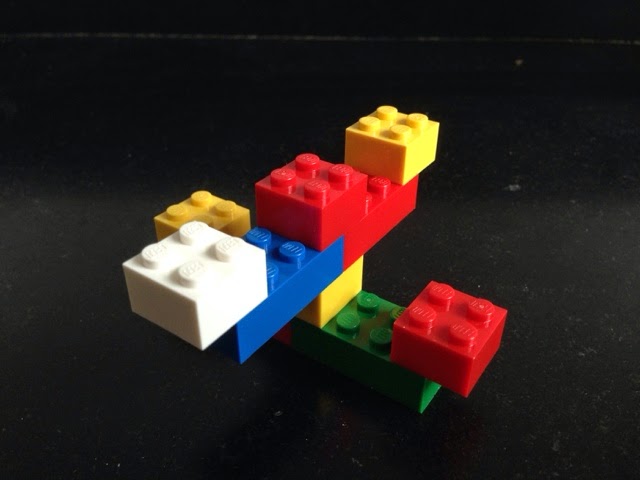
So let's look at a simple "monomer" (molecular building block) made from lego bricks. Keep in mind that color is irrelevant here, at least in this first attempt. 


Next let's look at a couple of monomers assembled together. 


How do they look from another angle (below)? What, if anything, does this tell is about spatial orientation in this structure?


What happens when we add more series of monomers? While assembling this structure what happens to its stability? How do different parts of the structure seem to relate to one another? What patterns emerge that we didn't see with just one or two monomers?


What does the angle we view this polymer at tell us? Does it matter which angle we view it from? Might it make a difference to another molecule trying to interact with this one?


Now let's pretend there there is some kind of interaction with an identical molecule or molecules. How does this change the picture?


And how do things change when we look at a close-up of this interaction? What kinds of changes are taking place at the surface, where pieces of the molecules connect to one another? Has the structure "changed" or is it the "same?" Is there something qualitatively different about this combination of identical monomers when we compare it to a single monomer?


And what happens when we view this structure from another angle? What are implications for further interactions when we look at the molecule from a new angle? What do we learn about the form of this thing when seen from a new angle?


Are there other patterns we can detect when we look further? Anything that might make a difference if you were trying to characterize this interaction or compare it to others?


Well that's a lot of work I think. Also introducing students to questions of stability, strength, etc. might be possible. We can also ask questions about simplicity vs complexity. Are these relative terms? How do we interpret them in the context of this exercise? What do they mean when we are analyzing biological systems, not just at the molecular level? 


Saturday, April 26, 2014

Evolution, Constraints, and Legos.

I spend a lot of time teaching my undergraduates about how constraints in the environment influence biological processes. From an evolutionary perspective we can call these constrains "selective pressures." In class I ask the students to brainstorm what these selective pressures might be. In students' minds it pretty much boils down to the availability of resources, through there are many other environmental constraints as well, such as climate, pathogens, and symbionts. 

But what bothers me about this exercise is that it's all pretty abstract. We can talk about resources and even think of examples. But it remains a kind of thought exercise without a compelling hook into the reality of biological systems. 

So the other day I picked up some Legos and started to model a termite mound, which incidentally is my favorite example for discussing environmental constraints with students. What looked like thousands of blocks began to appear quite inadequate by the time I had started an outer chamber to surround the inner chamber of my termite mound. I realized I would have to build more efficiently or much, much smaller as my supply of lego bricks dwindled. What would a termite colony do?

Aha! A way to teach about how constraints limit biological processes! Maybe I shouldn't order all those extra bricks after all. 


My barely started termite mound model. About at this point I ran out of bricks. 


Looking up into my termite mound, visualizing air flow. 

Friday, April 25, 2014

Legos for modeling science ideas

Teaching non-majors science I've always been interested in how we represent science ideas. My goal is to give students a chance to visualize and express science ideas on their own. There are so many ways to go about this. 

Just before YouTube got started I devised a "metavisualization" curriculum based on metacognition and visualization. My objective for that project was to engage students in making videos that conveyed scientific ideas. Some of the vids were great. Most of them reflected the last-minute effort that undergraduates put into assignments. I decided to drop the project after watching too many bad videos. 

Last year I got an arts initiative grant from my school. I used it to get students to do more hands-on, less cookbook labs. Some of the labs involved experiments the students made themselves, like seeing how water behaved in various situation. Others involved building with zometools, a simple yet sophisticated, infinitely flexible building set. All of the labs asked students to observe and reflect mindfully on what they were experiencing. 


I want to build on these labs next year. I did some research into the work they're doing at the MIT Media Lab and found the philosophies of learning coming out of there in coherence with mine. Ideas like "serious play" and "lifelong kindergarten" appeal to exactly the kind of learning environment I'm trying to build. The Media Lab is also a proponent of Legos. 

So I ordered a couple if lego sets to see if I could build some models with them. I unpacked the sets yesterday and experimented with a few ideas I'd like my students to pursue. One was a model of a termite mound. I had enough blocks to do a partial model. 


Then I worked on a couple of ideas for modeling polymers. I guess the possibilities are endless but here are a couple. 


Finally, I did a little experiment with genetic drift in two populations. I think it worked pretty well. 

1. A single population with randomly distributed variations. 


2. Two populations randomly isolated from one another. 


3. The process of genetic drift over a period of time. (Surviving populations in front).  The result: new species?


If you've worked with Legos in a university setting I'd love to hear your experiences. Most important, how did students respond?

Friday, November 1, 2013

Hypothesis in hyperspace


So I had a hypothesis. Actually an onion of a hypothesis with many layers to it. The core of the hypothesis was that we all have different styles of learning, visualizing, and interpreting. A truism that's almost trite. But not trite enough that we should forget about it when we teach, or when we design a learning environment. 

A layer out from that I hypothesized that students probably didn't understand a well-accepted scientific model: the fluid mosaic model of the phospholipid bilayer membrane. Irrelevant? Maybe. Except all living things have membrane systems. And teaching about membranes is central to biology. And membranes have been illustrated, modeled, and "visualized" in a million contexts including in our last lecture this week. 

My final hypothesis: that building a 3-D model of a membrane would be a hard task for my students. I couldn't do it myself, the first ten times I tried. 

I set my students to work first, by asking them to read one of my posts called "Permeability: just for cell membranes?" In that post I discuss lots of concepts of permeability, way beyond biology. I asked students to respond and if you go to that post you can see how they did. Pretty amazing actually. 

Next I asked students to connect the two concepts of permeability and evolution. A steep task but one that they lit nicely to. 

The major task of the day was for students to build a model of a membrane using Zometools, a wonderful toy I've been itching to introduce. 

Here are my findings. Students were intent upon depicting phospholipids. They did so quite literally, modeling the phosphate head and the hydrocarbon tails. Many wanted to depict both the saturated hydrocarbon tail and the unsaturated one. Some even wanted to include the glycerol that glues the two together. 


A moment of liberating fresh air came when I told my students they could look at the big picture and go abstract. They could represent the bilayer any way they wanted. Here they divided into two approaches: those who went 3-D and those who used the Zometools like colored lines flat on the lab bench surface. 


The next challenge was depicting the embedded proteins. We haven't studied proteins yet so it's no surprise many of the proteins depicted were just a single line. But it's worth it to mention I asked students to google images of membranes and refer to them, so anyone could have seen that the proteins have dimensional and not just linear qualities. 


Many students showed the proteins embedded horizontally, swimming between the two layers of phosphipids. This in spite of the fact that they were working off of lecture notes they had drawn as well as google images. 

Those students who depicted proteins arranged vertically did not show the proteins reaching past the phosphate heads, a biologically important feature. And the groups who did almost everything "right" were limited by the fact that their models presented a facies (just like I showed them in lecture!), just a slice of the cake, and not a whole sheet cake of membrane. 

An aha moment came when one student wore his Halloween sombrero to class. I suggested, what if we put two sombreros together and called the head part a protein?

Then I learned. Instruct the 2-D students to go 3-D. Instruct the protein people to orient their proteins vertically, to extend them beyond the structure of the bilayer, and bulk up the proteins. To those students who made a wonderful "slice" model I suggested: make three more of these, arrange them like four walls of a house, and build a protein up through the middle. 

Here are some of the results. I'm very happy with them! Next week we're building enzymes in lab to illustrate the lock and key active site. I'll ask these intrepid and intelligent students to make their proteins ten times the size of the substrate...about the size of a person. I have a feeling they'll impress me again. 


Thursday, October 3, 2013

Focus on Form

I had a delightful day in lab yesterday as my students struggled with finding, defining, and communicating about form. My doctoral work at Harvard and subsequent research focused on lichen form, so I thought I would give them a taste of one of my professional articles. The article was chock full of scanning electron micrographs, some of which I'm including in this post.


A theme of our course this semester has been looking beneath the surface. I'm trying to engage students in thinking about how to interpret the abstract messages that nature (and the world in general) send us. How do we go about interpreting our strange world? If we want to assert our agency in that world, and do it effectively, we have to interpret signals. Lichens with their strange seemingly abstract forms, difficult to put into any kind of familiar context, turn out to provide a great study instrument.

So as a warmup I asked students to tweet me their impressions of the figures in my article. People overwhelmingly wrote, "...it looks like..."  Bunny rabbit ears, coral, human hands and feet all appeared as descriptors. All focused on "visible" appearance though in nature, most form (I'm thinking molecular form) is observable though technically "invisible." This lab was also intended as a bridge to our next unit, where we will start looking at molecular interactions. If you don't think form is important in molecular biology think water. Or proteins. Or DNA.

After the warmup I asked students to consider a series of questions about form, its relationship to shape, and whether it only applies to living things.


Students put a lot of thought into their answers. I was inspired by all the work people invested in this lab, and I think they were too. As a biology professor I see my role less as a purveyor of biological "facts" and more as a learning coach. Especially focusing on how we solve problems, how we observe, and how we think and perceive. This is all connected with the new Boston University Arts Initiative. And I am a strong proponent as well of S.T.E.A.M., which includes arts in the traditional STEM (Science, Technology, Engineering, and Mathematics) way of thinking. It follows that the introductory essay I had my class read was "Thinking Critically with Aesthetics," authored of course by me. 

I just spoke with one of my students who's doing a double major in advertising and economics. He reports that his class at BU's COM school is similar to mine. Students are asked to think hard, innovate, collaborate, and communicate, a tall order that goes way beyond the old models of imparting and receiving information. 

Lichens were a fun thing for me to study. They presented a real intellectual challenge. But the work I'm doing now goes way beyond that challenge as I design learning environments for my undergraduates that get them thinking (and performing) in new ways. 

Incidentally I spent my time in lab responding to students' tweets. Instant feedback and thoughtful discourse. Can't beat that for an effective learning environment.


Tuesday, October 1, 2013

Genius of Landscape: Communal Built Environments and an Architectural Mystery in the Yucatan


Individuals, communities and societies build landscape. How societies form, how communities relate, what people do every day and all their lives reflects and builds landscape. Societies make landscape in different ways. All societies construct landscape communally. In fields, roads and cities, building and maintaining are collective endeavors. Tires, feet, exhaust – all part of a shared action – motion, erosion, corrosion. A pile of garbage, a garden, a coating of soot or fresh paint.


Prelude: Valladolid, a sleepy Yucatecan town, a place of conflict where the "caste wars" were fought by the Mayans, desperate for self-determination, economic and social freedom. Nightmares crawl up onto you from the blood spilled here.

Today Valladolid is cheerful, leafy and lively. Janet suggests we follow the "Route of Seven Churches" to get the lay of the land. First hesitating, then confidently, we follow the tourist information map. We see the spire of one church from the plaza of another churchwe visit. We drink a coke in the semi-shade of a tree filled with birds. 


We consider the flat landscape of Valladolid and its churches, every one replacing a Mayan pyramid. We reimagine the city in its Mayan incarnation, a different place but one still filled with people, markets, roadways and pyramids.

Continuation: Mérida, Yucatán’s capital, a pulsing city of over a million. Valladolid's “seven churches” are replaced by twenty or more. Walking the narrow colonial sidewalks, bathed in fumes from careening buses, this is a grey city for all its vibrancy, coated in the dust of exhaust and baked by tropical light. The buildings squat together in the hot light of noon or in late day shadows. Walking more than in Valladolid, we see more and we see less.

South of the city—a fork in the road. In ancient times, one road led to Ticul and trade in the interior, another to Campeche, the sea and beyond. Ancient geography superimposes itself. The modern place melts onto the bones of the old. Standing here, Mérida becomes real, not just a collection of shops, restaurants, hawkers, buses, trucks, and evening strollers. Mérida is history. What communal efforts built it?


The next day-a cool, rainy bus ride to Mayapán, supposedly the only Mayan ceremonial center that remained active into European times. At Mayapán – after a long ride into uncharted areas teeming with ruined pyramids in the middle of busy villages – we encounter a super deluxe coach carrying Germans, who have spilled onto the site. They are doing yoga on the buildings, kneeling and stuffing notes into cricks in the structures, possibly thinking about human sacrifice.

They leave, almost forgetting the smallest, weakest, oldest member of their group in her wheelchair. We have Mayapán to ourselves. In the wind and low sky of grey clouds, spitting raindrops, it is intense-- intensity of travel, intensity of site, intensity of an encounter with the plain lunacy of foreigners who travel with cognitive maps so clearly clashing with the place they visit. Mayapán looks like it was buried almost to the tips of its pyramids. It reminds us that much lies beneath.


On the bus back to Mérida we are chilled, tired and overwhelmed with the site, hard to interpret. In town we try for a Spanish (not Mexican) restaurant, are chased away by cigarette smoke and steep prices. We wander the downtown streets of Mérida hungry and thirsty, a head above the crowds that pack the workaday sidewalks. 

Janet points out a parking lot raised just above street level. On the far wall of the parking lot are two baroque columns, remains of a Spanish-era chapel. Why the chapel? And why is the parking lot raised in dead-flat Mérida? Obvious. It's sitting on temple ruins.


Is this whole city sitting on ruins? Is Mayapán, ruins itself, sitting on even deeper ruins? What about Valladolid and the surrounding villages? Is there any place in the Yucatán not sitting on ruins? How did they come to be buried? Some we know were recycled—contemporary roadside walls built from the whitewashed sacbeob stones, churches constructed from the rocks of temples and pyramids.


But the puzzle I've been trying to solve since I first came to the Yucatán: stucco walls decorated playfully, skillfully, boldly, with what appear to be random stone chips.


Experiment: Ceramics Studio, Boston University. Up here on the fifth floor I've been venting my creative instincts, finding new colleagues and new ways to play with clay, struggling with a project referencing the pillars of Ake, near Mérida, where I took dozens of photographs of amazing, outsized, isolated, windswept, sculptural stone pillars.


My ceramics experiment is a mixed bag. None of my miniature pillars sing with the energy and awareness of the real thing. I decide to carve, painstakingly, chipping off pieces of my small, imitation Ake pillars, coming to grips with the shape of the rocks I'm trying to depict, building a pile of random leather-hard clay chips—chips that look exactly like the random stone chips of the stucco walls in Valladolid. I return to my Flickr site, where I've faithfully recorded every picture that's worth sharing of my time in Mexico. I stare, breathless, at a wall in Downtown, Mérida, whitewashed but grey with soot and smoke, chock full of tightly packed, random-looking stones.


But those stones weren't random. They littered the streets of Valladolid (not yet Valladolid), and they littered the streets of Mérida (not yet Mérida), when the Spanish arrived. They were the chips left by generations of stonecutters – hundreds of years' worth – who trimmed the stones that built the temples, evidence of collective human work on the landscape. Colonists incorporated the chips into their stucco, and there they sit. Puzzle solved.

The ancestors of today's Mayans built a landscape of glorious cities of worship and power. The by-product: unassuming chipped stones piled in the streets, created over ages by many hands. The collective goal of the Mayan civilization was the building and upkeep of those cities. Every hand in society supported the priests, sacrifices and physical presence of the cities of ritual that became Valladolid and Mérida. Temples and pyramids were built from stones trimmed and chipped near these sites for hundreds of years. Landscape: a collective human endeavor.

Postlude: A visit to New York City and Ground Zero. "Occupiers" are still stationed at Zuccotti Park, a few steps away. The horrible, scarred landscape, the hole, the crowds, the bronze bas-relief of heroes of the NYPD, overwhelmed by a calamity beyond their ken and beyond their means to ameliorate. Yet all around the scene of disaster, all around the milling people, all surrounding the Occupy protesters soars the landscape of Wall Street, which we as a society continue to build with all our focus. Cranes pushing skyward, the landscape of the financial apparatus is the centerpiece of our communal efforts. Whatever we save, buy, eat or “invest” contributes to those buildings, to that financial "community.” I realize with a dollop of shame that these towers are our pyramids, this landscape of greed our bequest to the future.

This appeared as an article in Arcade Magazine 31:4

Thursday, September 26, 2013

Designing learning environments

I'm teaching science to non-science major undergraduates. How to start? The core curriculum I came into almost 20 years ago was a lock-step program with identical content, coursework, and exams for all 600 or so students. Four years ago our department was cut in half by a short-sighted administration that was swayed by departments outside of the sciences. About that time we decided to loosen our curricular approach, maintaining certain conceptual benchmarks that we could all teach in common. Even so it took me years to break out of the stereotypical "wet labs" that students had been doing for decades. Not only were the labs getting older, students had done equivalent work in high school. I had to break the mold to stay sane. 

A restful, stimulating sabbatical, initially denied me by the same dean who threw our department under the bus, was the key to my new lab approach. The core of that approach was to share with students my own ways of learning about nature and science. As a scientist and as an artist I have a profound relationship with the natural world. How could I share this with students?

Yesterday I got some inspiration as I watched students work through part of my lab. I gave them the link to my Flickr site, where I've assembled several hundred photos of flowers I took myself. I asked students to go through the photos, find one that they liked best, and tweet the photo to me along with the reason they chose it. Students simply came to lab, opened their laptops or phones, clicked on the link, and sank into a bed of floral eye candy. The oohs and ahs, the "I want to tweet every one of these," and the exclamations of "these are so beautiful" spoke for themselves. Instead of rushing through lab people spent time with the material. They engaged just because it was so aesthetically pleasing. 

The focus of my course this semester is how we can use aesthetics, broadly, as a problem solving algorithm in science and in everyday life. Designing my labs I've had to strategize how to introduce critical thinking through aesthetics at every possible opportunity. Along with that I've asked students to think about and analyze why they see things the way they do. Lots of focus, lots of discussion, and lots of written communication has gone into these labs so far. 

As people slip into lab and start to go about their business engaged, quiet at first, and focused, I'm getting a kind of automatic feedback on how well this designed learning environment is working.