Friday, October 23, 2015

At Moratuwa University

I am at Moratuwa University for the third year in a row. Last October, when I participated in the second annual student workshop connected to the International Conference of People, Places, and Cities, I had the sad feeling that it would be my last visit to Sri Lanka. Two proposals in two years had been rejected by the American Institute for Sri Lankan Studies (AISLS) and my first stab at the Fulbright had also received a thumbs down. I had another application to the Fulbright in the hopper but my hopes were not high. 


So here I am in the courtyard of the School of Architecture in the moments before the student workshop is set to begin. The familiar setting, the humid, muddy courtyard, the eager and dutiful students piling in to the conference room where only last night I participated in crits with the advanced masters students. The moments of calm before the flurry of activity, presentations, and discussions that will characterize the day's progression. 


What a great feeling to be here. I was picked up two hours early by my posse, the third year masters students who I spent the weekend with in Galle. The excitement, the activity, the unmistakeable feeling of "arrival" in a setting I had hoped for, I don't really know why, since my first visit here in 2013. 


Cultural landscape ecology, the interdisciplinary, somewhat intangible focus of my work here, is real. And every day I find out more about it in ever-unexpected dimensions. The soil scientist, a tried and true researcher who banks on the empirical, who tells me frankly that the ancient irrigation tanks were built by giants inspired by sutras. The journalist and urban planner who reports on cosmic forces that influence human behavior. The agronomist who swears that using different building materials changes the energy and fate of a space. These are real. As real as any "scientific" study of my topic. Real because they embody, or at least provide examples of the "culture" in "cultural landscape ecology."


So where am I in this process? Where am I heading? How to make sense of these and a million other interactions that spring from a collective human heart I have not read before?


To say that I'm pleased with how things have gone is a gross underestimate of my feelings. My frustration with no language skills is natural and I think positive, indicating to me the wish to reach out and understand more. Trying to put this all in a pedagogical or research context I can understand is hard. As hard as it is for Janet to wrap her head around the gross misuse of western medicines in a poor country with supposedly well-trained physicians and an Ayurvedic heritage all its own. 


So buildings stand and traffic roars and the ocean pounds the shore and money changes hands. But all these "realities" come to nothing in the broader vision of a place and its people who remain as mysteries to me one month in. 


Thursday, October 22, 2015

I came to see


I came to see water
And I came to see the tanks
I came to see the tanks
And I came to see flow
I came to see flow and I came to see energy
I came to see energy
And I came to see smoke
I came to see smoke
And I came to see temples
I came to see temples
And I came to see images
I came to see images
And I came to see the tanks


Wednesday, October 21, 2015

Three paintings and a landscape of abundance


My Fulbright in Sri Lanka has focused on cultural landscape ecology. With a strong interest in the amazing irrigation tanks of this place, some 30,000 human-built lakes that have been in use since ancient times, my research has taken me to spots of incredible beauty. These are not the kind of take-your-breath-away scenic marvels like the Canadian Rockies. In fact they are peaceful, gentle spots of intense intimacy. They are also emblematic of the abundance of this country. As the chief source of water for dozens of strains of rice that are native to Sri Lanka, the tanks and tank landscapes are synonymous with the culture of plenty that characterizes this generous land. 


This brings me to one of my favorite topics, iconography the study of images and symbols. Religious imagery abounds in Sri Lanka. You can't take a bus ride without running into a portrait of Lakshmi, the goddess of plenty. At almost every tank I've visited there is a shrine to Ganesha, the elephant god. And on less frequent occasions, especially in the North, I've had the delight of encountering Hanuman, the god of many positive attributes, not least of which is his monkey-like face. 


All of these gods embody or are associated with some aspect of plenty. In a recent trip to Jaffna, in Sri Lanka's far north I came across another religious image in front of a Hindu kovil that I've pondered upon. I can see that it depicts a conch shell. But can we interpret it else wise? Could this "vessel with wings" actually represent a kind of vision of plenty, with bounty overflowing its rim? Kind of a "cup runneth over" reminiscent of the stupendous spillways of irrigation tanks I saw last May after the rains?


Going only on instinct I decided to depict this image using my new oil paints and board. As I worked on and squinted at my emerging triptych it came, in my mind at least, to represent the gods I mentioned above. My paintings are abstract to the max but I hope you'll enjoy them. 


Here is Lakshmi. Instead of the lotus on which she's traditionally situated, I have her floating atop the furrow patterns you see in a typical rice field. 


Sorry I don't have a photo of her. As I look through my images there are so many of the other deities. 


Like Lakshmi, Ganesh is ubiquitous all over Sri Lanka, including the Sinhala Buddhist south. I was drawn to this runic Ganesh I saw next to a tank in the Dry Zone, painted on a rock. There are so many more. 


My Ganesh happens to have the suggestion of a bodhi leaf for a trunk. 


Finally, Hanuman. It seems the farther north you travel the more outrageous his depictions. This one was sitting in a cage outside of a kovil on an isolated road between a Point Pedro and Vallipuram, a long walk we undertook without getting lost. Maybe this Hanuman, who's covered with rolled betel leaves, was watching out for us. 


Monday, October 19, 2015

Awareness and a brick made of mud

Can we be aware of what we don't see? What about phenomena that escape our other senses? What is the dimension of awareness and how do we come to understand it? Is understanding itself necessary or will experience suffice?


This small country of Sri Lanka seems so huge. It is huge in natural treasures, the depth and complexity of its history, the hidden corners in plain sight and the hidden corners overgrown by jungle. You explore one place and there are 10,000 others to see. You explore 10,000 and there remain 1 million. 


Travel is easy but travel is hard. Distances are small but time and circumstance expand them. One place is green and the next place is greener. Even the decision to turn to the right or left stops you in the heat and noise of insects. 


You find one place in shimmering amazement and you are beckoned by the path further and deeper. Inertia and love holds you in thrall of the waves or the gentle lapping waters of a tank or the ripple of a river. 


A brick made of mud is still and stiller mud and the mud moves by turn in a flow or cascade. 


So. Awareness. The song of every corner and vantage. The wriggle of light and shadow in every expanse and fold. The cadence of languages just beyond intelligible to you as a stranger. But as a stranger you are drawn in and welcomed.


The Monk Who Flew a Kite: Taking an Interdisciplinary Fulbright to New Levels

I read in one of the English language papers here in Sri Lanka about a Buddhist monk who flies kites. It's not all he does according to the article but granted, it's a little out of the ordinary. But the article goes on to tell how he loved kite flying as a child, was ordained very young, and had to put aside his beloved activity for many years. 


Here I am a month into my Fulbright and in these weeks it would seem like we did "everything." From meeting with top researchers who are doing vital water management work to lecturing at Rajarata University to doing intense fieldwork with students from Rajarata and also here in Colombo at Moratuwa University, our time has been incredibly full. Spectacular walks in the countryside have inspired new ideas about cultural landscape ecology, my stated research activity here, and I have documented these walks in blog posts, photography, and even poetry (sometimes the impressions are so strong I find I can't contain them in prose!). We have savored the cuisine, the music, the people, the history, and of course the landscapes of Sri Lanka during these weeks. 


So in a word or two, Janet and I have embarked upon and accomplished a substantial amount of cultural and academic exchange. It's safe to say barely a day has gone by that we haven't experienced to the fullest, a real contrast to our everyday life at home where we work hard and do our best, but perhaps experience and feel less than we should. 


So it might come as a surprise that we spent this morning hunting down art supplies so that this Fulbrighter can start painting! I'm a scientist by training but I've been painting for a long time, in a damp dimly lit space in our basement. Just the same I love doing it when I get a chance. I've exhibited and sold my work but more important, enjoy giving it away to friends. I'm thinking that this rather solitary activity, deeply reflective and personal, will actually lead to more and not less social interactions. More chances to show the work to friends old and new, more chances to express my gratitude for the beauty and grace of this place, and the chance to set up my workspace in view of the Indian Ocean. 


I'm not a monk but the monk inspired me. As a scientist I'm deeply steeped in interdisciplinary work, one of the goals of my Fulbright. Why not pursue it by painting, something I've always loved doing? Of course, I'll keep my day job teaching and learning and interacting while I'm here. Can't help but do that. It's me. 


The photos in today's post are some examples of my work. Watch for more as the weeks go by and please do let me know what you think. 


Sunday, October 18, 2015

Design is an iterative process


So I just finished a weekend with excellent students from Moratuwa University who are in a seminar course on urban design. 

At the end of the weekend they showed me about 60 slides of graphics they prepared to depict data they've collected on a long-term project for a master plan for the UNESCO World Heritage Galle Fort. Some of the graphics were excellent. Some not so much. My criterion: did they tell a story or did they confuse? 

At the end of the "show" I was asked "so professor, how should we organize these slides for our 20-minute presentation next week?" Sixty slides in 20 minutes? A month's worth of work on nearly a dozen sites explained in this time, with each graphic's legend recited and explicated by the speaker? Nooooo!

Over the past couple of days we've been discussing ideas like "design is an iterative process" and "less is more," concepts that make less or more sense to the students depending on the moment and a moment's language proficiency. But one thing we've clarified is that design is a process. A process of uncovering and decisionmaking that includes moments of frustration and clarity by turn. One frustration is that all the students have questions about the theme of the conference "urban coherence" and what that can possibly mean. 


So I asked the students to think about this. Here they had worked for a long month, throwing themselves into a project they had to learn from scratch. When they came to Galle Fort they were clueless about the place or about what they had to learn. So they used their best powers of observation and collected the data depicted in their powerpoint slides. Strangely though, over the course of the weekend, as we took many walks together and engaged in endless conversations, they hadn't spoken with me about what was in their slides. They talked about movement, connectivity, sun, shade, and human striving. "So we need to sift through our data and come up with a presentation from that, right?," is the question I was eagerly asked. 

"Not exactly," was my reply. "All the stuff you talked to me about this weekend? None of it was even in your data."

What happened is this. The process of design research provided something better than answers--more effective than "solutions." It led to a whole new set of questions. Design is an iterative process where new questions are generated, new pathways of inquiry developed, and new insights gained as the process moves forward. This time around it took the students a month to come to this stage in their inquiry. Next project it will take a week. It's this process I'd like to see the students present to their peers later this week. 


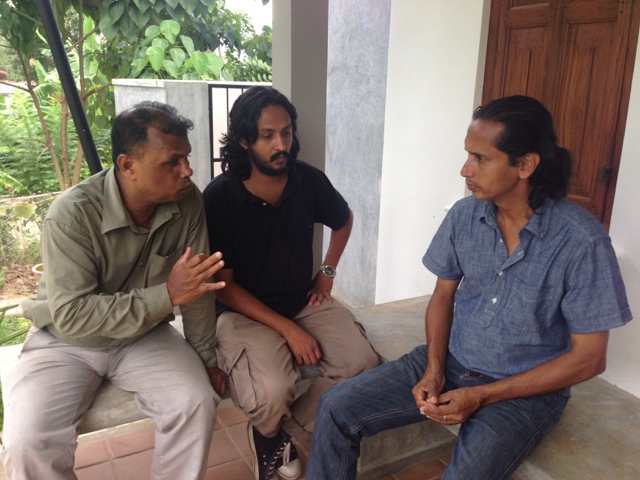
With students from Moratuwa University

Waking up early but not early enough perhaps to regain my equilibrium after a long day yesterday working with students from Moratuwa University. This in conjunction with an international student workshop that's slated for next Friday where I'm supposed to talk about urban coherence and incoherence, a slightly incoherent subject I think, which is the focus of the conference. 


It's 6:30 AM and I'm at a property some way out of Galle in a hilly-gully area studded with new construction. If I'm to guess by my absent host the houses were built by people like him, a banker. I've met him three times since we came and he's very hospitable. His place, pocket sized, immaculately designed and a bit roughly finished, was designed by one of the architects, Indika Ruparathne, who is in the master class I participated in (or taught) yesterday. 


As is the case about 100% of the time here I was in the dark about what we were doing, where we were going, and what we were to accomplish. Janet gamely came along, if only for the chance to re-visit Galle, which we visited two years ago on the cusp of its ascendency into a high-end retail and lodging destination with UNESCO heritage status. Along with us were four of the five students in this M-Arch program who ranged from a young protege of Janaka Wijesundara, my talented and accomplished colleague at Moratuwa, to a father of four in his forties, our media communications expert, who had just gotten off the night train from Jaffna, a nine hour trip he takes every weekend for this course. 


My "students" had spent several months studying Galle and especially the UNESCO-status Galle Fort, at one point spending a full week together onsite. To call them a tight cohort would not be an exaggeration, especially when they had the chance to break away from their duty of English conversation with us and had the chance to chatter, giggle, and roughhouse in Sinhala. This is what I've observed every time I've been in the company of junior faculty here, which is where at least a couple of them are headed. I haven't noticed this behavior among girls but for the record, there were no females in this coterie. 

To be fair I'd say with honesty that these people know their site. They've spent lots of time there. They know the terrain, the patterns, and the people. They claim to have done 200 interviews which is possible, though the "interviews" I observed were short and informal. No matter. These are Sri Lanka's future architects and planners and the standard of their learning, and more important, the quality of their questions is on par with my students at the BAC in Boston. 


Their main work is concerned with a master plan for Galle, a good idea since the World Heritage site at the Fort is sure to bring in more money and overspill its bounds. Galle town has to be developed in some kind of coherent way. But there I go again with the word "coherent." It's anybody's guess. The most accomplished architect in the group maintained a prissy attitude about the "disorganization" of the fish market, calling it "disordered" and "undisciplined," labels I can't accept personally, while another group member stressed the need for shade and people's need to move through (not sit) as they perform their daily tasks.  


So there is so much room for interpretation it's hard to know what they think as a group or how they've anchored their ideas or how they will present their work in a few days. 


Some observations are perhaps in order. I watched group decisionmaking over lunch and was impressed by how much conferring and cross-conferring needed to be fine before we could order. Ultimately everyone got the same thing-a family style fried rice and curry and everyone bent down and got to work. 


So many questions during our work. So many stated ideas and opinions. Sometimes people would both talk at the same time and it reminded me of when my twins were small and addressed me simultaneously with their burning concerns. 


We spent hours it seemed circling the Fort, trying out, repeating, restating ideas in a kind of circular way that matched our circumambulations. There were times it seemed like we weren't getting anywhere, times when group members disappeared but multiple phone calls were made back and forth. Times when the same divergent opinions were repeated seemingly endlessly. 


As a foreigner it became I thought impossible to decipher how people were communicating, what they might be communicating, or how I should respond. With one student I could see no point of agreement. No matter how politely I listened I couldn't seem to swallow what he said. Finally I took a direct approach and told him I didn't agree or worse, told him I disagreed. No matter. He kept explaining his philosophy to me. So is this a way problem solving is done? Just keep going around and around with ideas until some aspects of everyone's ideas are incorporated into a group consensus?


There were times that were frustrating and times that were maddening and times I thought I would die of thirst and times I choked on cigarette smoke or exhaust. Times the noise of trucks or kotti making stopped all conversation and times a heavily accented English just became too hard to understand. 

In the end our conversations were incredibly productive. Finally a series of questions was put to me: how should the presentation focus? What's the difference between an urban designer and an urban planner? How much must a designer know? And how much of their knowledge do designers have to incorporate into their work?


I found myself with a group of deeply curious students, well informed, and with a thirst for more answers. Answers which I couldn't pretend to provide. So in the end I threw back a few questions, digging deep to keep the questions good natured. I was way overtired. And then this morning came the students' response. 


"The questions you threw at us made us search for answers. And as we searched for answers to your questions we found answers to our own."

What better way to spend a weekend with a group of well-prepared students who were primed to learn and interact? A wonderfully rewarding experience for me and one that I hope will perpetuate many more discussions with these wonderful students.