Saturday, May 30, 2015

How do people use their landscape?

We live in our landscape and our landscape is an expression of our culture. So I think for most of us we don't pay attention to patterns of landscape use when we are at home. Traveling is another story, especially if we get out of the car. For example the impressions came tumbling in during a two week preparatory visit to Sri Lanka, where I was setting up protocols for my upcoming Fulbright. 


When you're there you can't help noticing the way people situate themselves in the landscape. Somehow it's "different" than the way we do things in the west. For example patterns that characterize the way people hang out in their landscape in Sri Lanka seemed distinctive to me. They became even more distinctive when after a day's rest in Boston, I came out to the Azores to work with colleagues on some educational initiatives. 


To a visitor at least, Ponta Delgada, The capital of the Azores, looks like a pretty quiet place. Especially away from the city center, the streets are fairly broad and the sight of people walking is seems rare. This is my second visit to the Azores so my impression of a quiet place was reinforced. There are however particular spots that are quite busy. For example a shopping mall (Parque Atlantico) near the center of town may be bustling while the streets around it are fairly deserted. The strip of restaurants and stores along the harbor also tend to be busier than the streets right behind them. If I had to use one word to describe the place, and I admit that this is biased by my own subjectivity, I would call it "quiet."

By contrast, Galle Road in Colombo might be considered "wild," at least at first glance. As a foreigner in Colombo the Galle Road appears untamed, chaotic, edgy, and perhaps dangerous. At least until you relax and get used to it. Walking a 1 km stretch of Galle Road from Hotel Road south to Templers Road, I came to discover that it had its own patterns of stillness and congestion. For example, the immediate vicinity of the Mount Lavinia bus stand seems to have people walking in every direction, crossing streets at every angle, and using a variety of vehicles in a variety of ways. Certain spots on the same stretch of road are quieter. But people negotiating irregular pavements, large puddles, and vehicles pulling in and out of spaces do give that stretch of road its particular character. If this sounds general, it is, because this is the very first time I'm writing down my impressions of the space. 


Galle Road dominates the western edge of Colombo, but it's not the only place in town. A few blocks to the east can take you to broad and shady residential streets that are practically as quiet as Ponta Delgada. And a visit to the ancient neighborhood of Slave Island uncovered a whole different set of landscape patterns, which I hope to study in detail during my Fulbright. 


I noticed Colombo landscapes more poignantly after spending a week in the countryside of Sri Lanka. In the countryside there are some similarities with Colombo, for example congested city centers like Anuradhapura and bustling village centers like nearby Mihintale. When I visited Adampan village in the Mannar District I "discovered" a kind of hybrid, busy but not congested. This sort of hybrid landscape use seemed to be mirrored along some side roads in the countryside near Mihintale, with a significant difference. In Adampan, just like along the Galle Road there are people sitting in storefronts, in their tuk-tuks, and at various shady spots. This sitting is mixed in with lots of movement. I should add that not all the movement is oriented to "getting someplace." For example I stopped with my friend and colleague Dominic Essler to buy petrol for his motorcycle. There was plent of movement around the shop filling canisters, measuring, taking money, and examining his cycle. But on some of the back roads in the countryside there seemed to be just movement from one place to another, for example steady bicycle or foot traffic spaced by intervals of quiet. 


Lots of impressions here with no single narrative thread. But I think I want to study this further and work on some kind of analysis. 


Tuesday, May 26, 2015

Playing with Your Food

In my last post I discussed "intelligence of the hands and feet," something I've known about intellectually but thought about that much before. It occurred to me that the whole question in Sri Lanka of eating with the hands is part of this bigger picture. 


This was my fourth visit to Sri Lanka so I had seen people using their hands to eat on many occasions. I have to say that it grossed me out. The idea of handling wet food with one's hands was just something I couldn't make peace with. 

Until this visit. Thanks to determination and close observation. Eating with the hands is not, as it would seem, shoveling food into your mouth willy nilly. The hands are used in ways that no utensil can duplicate. For example, say you're eating a fish of rice, curry, and dahl. Your first step is to sort of feel out the ingredients and mix them together in a preliminary way. I use my thumb to squeeze the ingredients together gently. 

As you combine and eat you begin to discover. The dishes, for example sambol, are a mixture of ingredients. With the tips of your fingers you find larger, harder, or inedible bits. For example, onions are hard for me to digest and by using my thumb and forefingers I can sort through a sambol and kind of push, or even place the onions to the side. 

All the time that you're eating you're rearranging the food on the plate. I haven't watched people that closely but for me it's satisfying to continue to mix and arrange, bringing the shrinking pile of food closer to me. 

String hoppers, which I had for most of my guesthouse breakfasts, are a slightly different story. You can mix them with your food or you can use them as kind of soft mini tacos into which you can put morsels of whatever you want. 


My last morning I was served "green gram" which, from what I can tell, was just boiled mung beans. It might have been an uninspiring part of the meal if I was stuck using a fork. Instead, I found myself squeezing little fingerfuls of the beans, arranging them with the grated coconut and spicy chiles with cabbage I was served. This way the flavor of the beans came through and my probing, squeezing fingers acted as a sort of first stage in digestion, mashing the beans before they came into my mouth. 

If, as I think, you gain knowledge through your fingers, this way of eating provides you with further knowledge about what you're eating. You experiment with proportions, textures, and flavors, making each bite a little different. What grossed me out at first is actually a way to elevate the culinary experience, highlighting the complexity and delicacy of Sri Lankan cuisine. 

Knowledge of the Feet and Hands

If you ever go to Sri Lanka you'll see that people have their shoes off a lot of the time. Not just shoes, but even when they have a chance to get their feet out of a pair of sandals they'll do it. Everyone. Not just tuktuk drivers. I was at the university the other day and my colleagues had slipped off their sandals. It's one of the things I have in common with people here. We don't like our feet cooped up. 


Toes, heels, soles, ankles--parts of people's feet seem to be in a constant state of exploration. Or when their not exploring, in graceful repose. I'm not as good as them at using my feet to divine the environment. But I'm working on it. 

On a more serious note, exploring the rice fields and small irrigation tanks last week I couldn't help but notice that people were naturally barefoot everywhere in the vicinity of the ponds. Most striking to me were the barefoot cultivators on small rice paddy dikes and in the ponds that were being newly flooded for the Yala (secondary) crop. 


A look at the rice fields in their shades of green and gray, glistening with young rice or readying mud, revealed something else. These fields, intricately worked and leveled by human agency over millennia, have been shaped in part by innumerable bare feet. It follows that the humble rice cultivator, the farmer who builds the dikes, levels the fields, cuts the channels, spreads the seed, sprays the pesticide, scatters the fertilizing pellets, tends the plants, and harvests the rice, does all of this work barefoot. And so generations of Lankans have worked this way, thanks to a knowledge of their immediate environment as sensed through their feet. Where I feel pavement through layers of material, the Sri Lankan farmer knows the soil through the bottoms of his feet. This to me indicates a profound difference in the way we experience our world one from the other. 


The fact that generations of feet have built the landscape of rural Sri Lanka through a sort of "foot-knowledge" is a fact worth celebrating on its own. But what does it have to do with what I'm calling "knowledge of the hands?" 

In Colombo I asked my hosts where I could find someone to give me a head massage. I'd experienced one in rural Mihintale, a story of its own, and I wanted to repeat the experience. They pointed me to the Sippaheluda Ayurvedic Hsopital, about a mile from my guesthouse. After my head massage there I decided to come back the next day for a full-body massage, something I've done only once before. I have to say I'm a bit skeptical about the benefits of massage but this changed my mind once and for all. The full-body massage provided an unexpected experience, strangely encouraging, one of those intangibles I discussed in my last post. And after it I decided to book for another massage for a couple of days later. 

My second massage is what made me think about the connection between knowledge of the feet and knowledge of the hands. The massage therapist was the same as the time before, but his massage was different. As his hands probed and manipulated, I could feel that he'd assessed on my first visit the condition of my skin, bones, muscles, and organs. Without telling him a thing about how I felt or where I had old injuries or discomforts, his hands and fingers anticipated the contours of my body. He knew through his hands. Through his hands he learned about and in a way, changed my body's history, the same as rice farmers, through their feet, know and renew the landscape of cultivation season after season. 


A rare brush with the intangible. A set of intangibles that nevertheless influence profoundly the natural and human environment around them. 

Saturday, May 23, 2015

What about the unexpected?

A few years ago I was looking at Aztec sculpture and architecture in Mexico City when it struck me. I was looking at a world of curves, angles, and dimensions that was totally new to me. And unexpected. 


I went on to develop some further thoughts on this. In particular I began to wonder, how do we learn from experiencing the new? How do we assimilate physical space, sound, and movement we've never encountered before? How do we develop a narrative based on these intangibles? Is it desirable that we build such a narrative?

Using some of these questions I constructed a series of exercises for my undergraduates at Boston University and for my graduate students at the Boston Architectural College. I guess I could summarize my teaching goals this way: there have been lots of great thinkers, Darwin for example. But I don't want to teach my students what Darwin discovered. I want to set them on a path of discovery themselves. That path is lain on stepping stones of intangible, unexpected perceptions. 


Fast forward to my current encounter with the Sri Lankan landscape. It holds in store a world of new sensations, new shapes and lines, new dimensions, new sounds, and new movements. Most striking to me on this recent trip was a lotus leaf on an ancient irrigation tank, the morning after a rainfall. The random, scarcely controlled movement of water on the leaf as it blew in the wind, perhaps a mundane sight in rural Sri Lanka, possessed an electrifying novelty for me. 


Can we learn anything from these mundane novelties? I propose that on many levels, we can. For one, they open our brains in new ways. They present novel conditions that require some re-wiring in order to be understood. The more we undertake re-wiring the more we are prepared to keep on learning.  

At another level, we may apply known scientific narratives, for example an understanding of the properties of water, to phenomena like this. The movement of water in the leaf is attributable to cohesion, adhesion, and mass flow. From another angle we may illuminate known cultural or religious concepts like "the lotus leaf and the lotus flower hold nothing in possession."

From yet another perspective we may come to value impressions of the novel as a compendium of unknowns--phenomena that may, in some future moment prove useful in some material or immaterial way. What is valueless today may hold the key to unknown, uncounted treasures tomorrow. Or am I just shooting the breeze with this kind of conjecture?


Is it worth traveling halfway around the world to accumulate a series of intangible perceptions? I am here to find out. 

Friday, May 22, 2015

Starting Over: The Sri Lankan Odyssey

In March I learned that I was granted a Fulbright award to Sri Lanka for 2015-2016. It's something I've been trying for for a couple of years so the moment was sweet. First thing after I  opened the acceptance letter I tweeted "Got the Fulbright. Trying to breathe." Then I remember walking up 5th Avenue in New York. I kept saying out loud "I got the Fulbright" and felt head and shoulders above the crowds. 


Just before I found out, I had booked a two week trip to Sri Lanka for May, scheduled to coincide with the end of my semester at Boston University. I figured then that it would be my last trip to Sri Lanka since I had pretty much given up hope of getting a positive response from the Fulbright. 

Here I am at the end of those two weeks. Yesterday I dropped in at the Fulbright office in Colombo and was invited to attend the half-year program review of the current batch of grantees. A couple of US professors presented their research here and notably, the six ETAs (English Teaching Assistants) presented their work. These kids, recent college graduates, told compelling stories of their experience here in Sri Lanka. They bring passion to their teaching practice, and most of them conduct  creative, inspired "side projects" that show incredible intelligence, commitment, and bravery. The ETAs show real love for Sri Lanka in their work, and for all of them, this experience of self-generated exploration holds the kernel of their future life/career experiences. All of the students' talks inspired me. 


What inspired me further is that some of the students are recording their work in blogs. Aha! I realized I could re-inaugurate my blogspace writing about my thoughts and experiences here in Sri Lanka. So this is my first entry. I'll be recording my observations in both of my blogs, "Scientist-Artist" and "Botany Without Borders." The blogs, which I stopped writing a couple of years ago, were a wonderful format that opened up heaps of opportunities for me. They also provided me with a jumping-off point for overhauling my approach to teaching. What a great tool! So here we go again. Let's see where it all leads. 
 

Sunday, November 16, 2014

Capturing Movement in Mexico City

Mexico City, Tenochtitlan, a huge living sculpture, a built environment whose immediacy sits on the surface of a dense and teeming historicity. The land, a bowl surrounded by mountains, sinks as it evolves, sculpted by tectonic and human forces that slide, accrete, press, and tunnel. South: Chinampas, a living collaboration of humans and nature. North: Teotihuacan, the collaboration of humans and heaven. In the Centro Historico the monumental Zocalo lies juxtaposed, pulsing between palaces and ruined temples, teeming markets and packed streets.


People here join and shape the living urban sculpture, a millennial continuum of movement: Hurried, clustered, selling, strolling, digging, parking, building. Climbing the stairs of innumerable churches, government buildings, markets, monuments, subways. opening and closing a million windows and doors of a million apartments and cars. Green spaces, plazas, fountains, roadways, murals, graffiti, all moving through growth, flow, stretching, covering, adding to the fabric of the city. And always, the slow movement downward of a city sinking into the lake that is its foundation.


Movement has always been a part of this city. The God of Earthquakes, Olin, is also the god of movement. The symbol for Olin, which is also the symbol for earthquakes and movement, can be found in all kinds of iconography in and around Mexico City. As we learn more about how this city moves, it is fascinating to see that an understanding of movement has always been important to the people living here. 


Thursday, May 22, 2014

Nano modeling with lego bricks

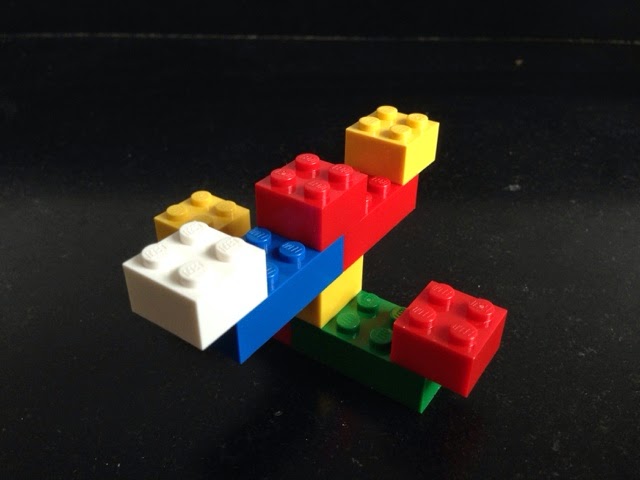
Working on a lab for next year's introductory biology course (non-majors). This could fit in at the beginning when we discuss the origin of life (increasing complexity leading to increasing order). Maybe students would challenge this because increasing complexity in these lego models looks more chaotic (!) or the exercise could fit later in the semester when we study polymers (polypeptides, polysaccharides, etc.). Deciding where it would make the most impact depends on a lot of factors, almost all of them external to the content of the course! 

The key is to keep my students engaged in the process of studying, to think about questions and permutations of questions, and to encourage them to develop ideas. Congruent to this is that I want them to see the lego structures less as "built" objects but "developed" objects...structures that tend to function in certain ways depending on how they are organized...not necessarily things that have to be "big" or "long" (or any particular quality of a polymer)...just things to contemplate. This is one of the great beauties of teaching science to non-majors. The content is less important than the process. But it's also a challenge. Students have been taught that science is about defining, memorizing, and regurgitating. So much different from the way we scientists see things, which is that the natural world is a space open to exploration and interpretation. Asking questions about form in space is the goal of this lab. This is the rigor that I want to impart. 

So let's look at a simple "monomer" (molecular building block) made from lego bricks. Keep in mind that color is irrelevant here, at least in this first attempt. 


Next let's look at a couple of monomers assembled together. 


How do they look from another angle (below)? What, if anything, does this tell is about spatial orientation in this structure?


What happens when we add more series of monomers? While assembling this structure what happens to its stability? How do different parts of the structure seem to relate to one another? What patterns emerge that we didn't see with just one or two monomers?


What does the angle we view this polymer at tell us? Does it matter which angle we view it from? Might it make a difference to another molecule trying to interact with this one?


Now let's pretend there there is some kind of interaction with an identical molecule or molecules. How does this change the picture?


And how do things change when we look at a close-up of this interaction? What kinds of changes are taking place at the surface, where pieces of the molecules connect to one another? Has the structure "changed" or is it the "same?" Is there something qualitatively different about this combination of identical monomers when we compare it to a single monomer?


And what happens when we view this structure from another angle? What are implications for further interactions when we look at the molecule from a new angle? What do we learn about the form of this thing when seen from a new angle?


Are there other patterns we can detect when we look further? Anything that might make a difference if you were trying to characterize this interaction or compare it to others?


Well that's a lot of work I think. Also introducing students to questions of stability, strength, etc. might be possible. We can also ask questions about simplicity vs complexity. Are these relative terms? How do we interpret them in the context of this exercise? What do they mean when we are analyzing biological systems, not just at the molecular level?