Saturday, May 23, 2015

What about the unexpected?

few years ago I was looking at Aztec sculpture and architecture in Mexico City when it struck me. I was looking at a world of curves, angles, and dimensions that was totally new to me. And unexpected. 


I went on to develop some further thoughts on this. In particular I began to wonder, how do we learn from experiencing the new? How do we assimilate physical space, sound, and movement we've never encountered before? How do we develop a narrative based on these intangibles? Is it desirable that we build such a narrative?

Using some of these questions I constructed a series of exercises for my undergraduates at Boston University and for my graduate students at the Boston Architectural College. I guess I could summarize my teaching goals this way: there have been lots of great thinkers, Darwin for example. But I don't want to teach my students what Darwin discovered. I want to set them on a path of discovery themselves. That path is lain on stepping stones of intangible, unexpected perceptions. 


Fast forward to my current encounter with the Sri Lankan landscape. It holds in store a world of new sensations, new shapes and lines, new dimensions, new sounds, and new movements. Most striking to me on this recent trip was a lotus leaf on an ancient irrigation tank, the morning after a rainfall. The random, scarcely controlled movement of water on the leaf as it blew in the wind, perhaps a mundane sight in rural Sri Lanka, possessed an electrifying novelty for me. 


Can we learn anything from these mundane novelties? I propose that on many levels, we can. For one, they open our brains in new ways. They present novel conditions that require some re-wiring in order to be understood. The more we undertake re-wiring the more we are prepared to keep on learning.  

At another level, we may apply known scientific narratives, for example an understanding of the properties of water, to phenomena like this. The movement of water in the leaf is attributable to cohesion, adhesion, and mass flow. From another angle we may illuminate known cultural or religious concepts like "the lotus leaf and the lotus flower hold nothing in possession."

From yet another perspective we may come to value impressions of the novel as a compendium of unknowns--phenomena that may, in some future moment prove useful in some material or immaterial way. What is valueless today may hold the key to unknown, uncounted treasures tomorrow. Or am I just shooting the breeze with this kind of conjecture?


Is it worth traveling halfway around the world to accumulate a series of intangible perceptions? I am here to find out. 

Friday, May 22, 2015

Starting Over: The Sri Lankan Odyssey

In March I learned that I was granted a Fulbright award to Sri Lanka for 2015-2016. It's something I've been trying for for a couple of years so the moment was sweet. First thing after I  opened the acceptance letter I tweeted "Got the Fulbright. Trying to breathe." Then I remember walking up 5th Avenue in New York. I kept saying out loud "I got the Fulbright" and felt head and shoulders above the crowds. 


Just before I found out, I had booked a two week trip to Sri Lanka for May, scheduled to coincide with the end of my semester at Boston University. I figured then that it would be my last trip to Sri Lanka since I had pretty much given up hope of getting a positive response from the Fulbright. 

Here I am at the end of those two weeks. Yesterday I dropped in at the Fulbright office in Colombo and was invited to attend the half-year program review of the current batch of grantees. A couple of US professors presented their research here and notably, the six ETAs (English Teaching Assistants) presented their work. These kids, recent college graduates, told compelling stories of their experience here in Sri Lanka. They bring passion to their teaching practice, and most of them conduct  creative, inspired "side projects" that show incredible intelligence, commitment, and bravery. The ETAs show real love for Sri Lanka in their work, and for all of them, this experience of self-generated exploration holds the kernel of their future life/career experiences. All of the students' talks inspired me. 


What inspired me further is that some of the students are recording their work in blogs. Aha! I realized I could re-inaugurate my blogspace writing about my thoughts and experiences here in Sri Lanka. So this is my first entry. I'll be recording my observations in both of my blogs, "Scientist-Artist" and "Botany Without Borders." The blogs, which I stopped writing a couple of years ago, were a wonderful format that opened up heaps of opportunities for me. They also provided me with a jumping-off point for overhauling my approach to teaching. What a great tool! So here we go again. Let's see where it all leads. 
 

Sunday, November 16, 2014

Capturing Movement in Mexico City

Mexico City, Tenochtitlan, a huge living sculpture, a built environment whose immediacy sits on the surface of a dense and teeming historicity. The land, a bowl surrounded by mountains, sinks as it evolves, sculpted by tectonic and human forces that slide, accrete, press, and tunnel. South: Chinampas, a living collaboration of humans and nature. North: Teotihuacan, the collaboration of humans and heaven. In the Centro Historico the monumental Zocalo lies juxtaposed, pulsing between palaces and ruined temples, teeming markets and packed streets.


People here join and shape the living urban sculpture, a millennial continuum of movement: Hurried, clustered, selling, strolling, digging, parking, building. Climbing the stairs of innumerable churches, government buildings, markets, monuments, subways. opening and closing a million windows and doors of a million apartments and cars. Green spaces, plazas, fountains, roadways, murals, graffiti, all moving through growth, flow, stretching, covering, adding to the fabric of the city. And always, the slow movement downward of a city sinking into the lake that is its foundation.


Movement has always been a part of this city. The God of Earthquakes, Olin, is also the god of movement. The symbol for Olin, which is also the symbol for earthquakes and movement, can be found in all kinds of iconography in and around Mexico City. As we learn more about how this city moves, it is fascinating to see that an understanding of movement has always been important to the people living here. 


Thursday, May 22, 2014

Nano modeling with lego bricks

Working on a lab for next year's introductory biology course (non-majors). This could fit in at the beginning when we discuss the origin of life (increasing complexity leading to increasing order). Maybe students would challenge this because increasing complexity in these lego models looks more chaotic (!) or the exercise could fit later in the semester when we study polymers (polypeptides, polysaccharides, etc.). Deciding where it would make the most impact depends on a lot of factors, almost all of them external to the content of the course! 

The key is to keep my students engaged in the process of studying, to think about questions and permutations of questions, and to encourage them to develop ideas. Congruent to this is that I want them to see the lego structures less as "built" objects but "developed" objects...structures that tend to function in certain ways depending on how they are organized...not necessarily things that have to be "big" or "long" (or any particular quality of a polymer)...just things to contemplate. This is one of the great beauties of teaching science to non-majors. The content is less important than the process. But it's also a challenge. Students have been taught that science is about defining, memorizing, and regurgitating. So much different from the way we scientists see things, which is that the natural world is a space open to exploration and interpretation. Asking questions about form in space is the goal of this lab. This is the rigor that I want to impart. 

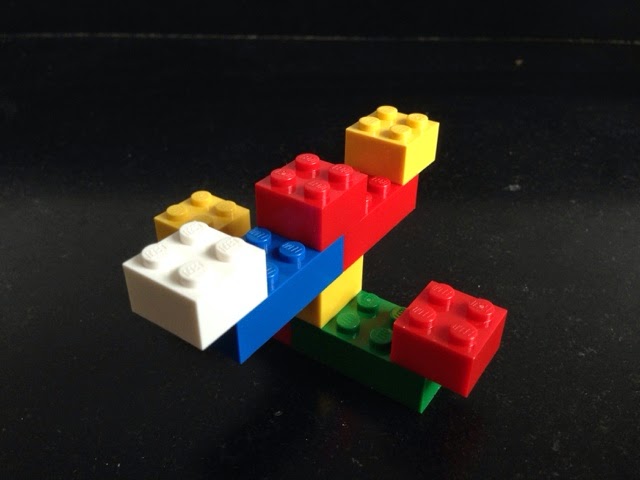
So let's look at a simple "monomer" (molecular building block) made from lego bricks. Keep in mind that color is irrelevant here, at least in this first attempt. 


Next let's look at a couple of monomers assembled together. 


How do they look from another angle (below)? What, if anything, does this tell is about spatial orientation in this structure?


What happens when we add more series of monomers? While assembling this structure what happens to its stability? How do different parts of the structure seem to relate to one another? What patterns emerge that we didn't see with just one or two monomers?


What does the angle we view this polymer at tell us? Does it matter which angle we view it from? Might it make a difference to another molecule trying to interact with this one?


Now let's pretend there there is some kind of interaction with an identical molecule or molecules. How does this change the picture?


And how do things change when we look at a close-up of this interaction? What kinds of changes are taking place at the surface, where pieces of the molecules connect to one another? Has the structure "changed" or is it the "same?" Is there something qualitatively different about this combination of identical monomers when we compare it to a single monomer?


And what happens when we view this structure from another angle? What are implications for further interactions when we look at the molecule from a new angle? What do we learn about the form of this thing when seen from a new angle?


Are there other patterns we can detect when we look further? Anything that might make a difference if you were trying to characterize this interaction or compare it to others?


Well that's a lot of work I think. Also introducing students to questions of stability, strength, etc. might be possible. We can also ask questions about simplicity vs complexity. Are these relative terms? How do we interpret them in the context of this exercise? What do they mean when we are analyzing biological systems, not just at the molecular level? 


Saturday, April 26, 2014

Evolution, Constraints, and Legos.

I spend a lot of time teaching my undergraduates about how constraints in the environment influence biological processes. From an evolutionary perspective we can call these constrains "selective pressures." In class I ask the students to brainstorm what these selective pressures might be. In students' minds it pretty much boils down to the availability of resources, through there are many other environmental constraints as well, such as climate, pathogens, and symbionts. 

But what bothers me about this exercise is that it's all pretty abstract. We can talk about resources and even think of examples. But it remains a kind of thought exercise without a compelling hook into the reality of biological systems. 

So the other day I picked up some Legos and started to model a termite mound, which incidentally is my favorite example for discussing environmental constraints with students. What looked like thousands of blocks began to appear quite inadequate by the time I had started an outer chamber to surround the inner chamber of my termite mound. I realized I would have to build more efficiently or much, much smaller as my supply of lego bricks dwindled. What would a termite colony do?

Aha! A way to teach about how constraints limit biological processes! Maybe I shouldn't order all those extra bricks after all. 


My barely started termite mound model. About at this point I ran out of bricks


Looking up into my termite mound, visualizing air flow. 

Friday, April 25, 2014

Legos for modeling science ideas

Teaching non-majors science I've always been interested in how we represent science ideas. My goal is to give students a chance to visualize and express science ideas on their own. There are so many ways to go about this. 

Just before YouTube got started I devised a "metavisualization" curriculum based on metacognition and visualization. My objective for that project was to engage students in making videos that conveyed scientific ideas. Some of the vids were great. Most of them reflected the last-minute effort that undergraduates put into assignments. I decided to drop the project after watching too many bad videos. 

Last year I got an arts initiative grant from my school. I used it to get students to do more hands-on, less cookbook labs. Some of the labs involved experiments the students made themselves, like seeing how water behaved in various situation. Others involved building with zometools, a simple yet sophisticated, infinitely flexible building set. All of the labs asked students to observe and reflect mindfully on what they were experiencing. 


I want to build on these labs next year. I did some research into the work they're doing at the MIT Media Lab and found the philosophies of learning coming out of there in coherence with mine. Ideas like "serious play" and "lifelong kindergarten" appeal to exactly the kind of learning environment I'm trying to build. The Media Lab is also a proponent of Legos. 

So I ordered a couple if lego sets to see if I could build some models with them. I unpacked the sets yesterday and experimented with a few ideas I'd like my students to pursue. One was a model of a termite mound. I had enough blocks to do a partial model. 


Then I worked on a couple of ideas for modeling polymers. I guess the possibilities are endless but here are a couple. 


Finally, I did a little experiment with genetic drift in two populations. I think it worked pretty well. 

1. A single population with randomly distributed variations. 


2. Two populations randomly isolated from one another. 


3. The process of genetic drift over a period of time. (Surviving populations in front).  The result: new species?


If you've worked with Legos in a university setting I'd love to hear your experiences. Most important, how did students respond?

Friday, November 1, 2013

Hypothesis in hyperspace


So I had a hypothesis. Actually an onion of a hypothesis with many layers to it. The core of the hypothesis was that we all have different styles of learning, visualizing, and interpreting. A truism that's almost trite. But not trite enough that we should forget about it when we teach, or when we design a learning environment. 

A layer out from that I hypothesized that students probably didn't understand a well-accepted scientific model: the fluid mosaic model of the phospholipid bilayer membrane. Irrelevant? Maybe. Except all living things have membrane systems. And teaching about membranes is central to biology. And membranes have been illustrated, modeled, and "visualized" in a million contexts including in our last lecture this week. 

My final hypothesis: that building a 3-D model of a membrane would be a hard task for my students. I couldn't do it myself, the first ten times I tried. 

I set my students to work first, by asking them to read one of my posts called "Permeability: just for cell membranes?" In that post I discuss lots of concepts of permeability, way beyond biology. I asked students to respond and if you go to that post you can see how they did. Pretty amazing actually. 

Next I asked students to connect the two concepts of permeability and evolution. A steep task but one that they lit nicely to. 

The major task of the day was for students to build a model of a membrane using Zometools, a wonderful toy I've been itching to introduce. 

Here are my findings. Students were intent upon depicting phospholipids. They did so quite literally, modeling the phosphate head and the hydrocarbon tails. Many wanted to depict both the saturated hydrocarbon tail and the unsaturated one. Some even wanted to include the glycerol that glues the two together. 


A moment of liberating fresh air came when I told my students they could look at the big picture and go abstract. They could represent the bilayer any way they wanted. Here they divided into two approaches: those who went 3-D and those who used the Zometools like colored lines flat on the lab bench surface. 


The next challenge was depicting the embedded proteins. We haven't studied proteins yet so it's no surprise many of the proteins depicted were just a single line. But it's worth it to mention I asked students to google images of membranes and refer to them, so anyone could have seen that the proteins have dimensional and not just linear qualities. 


Many students showed the proteins embedded horizontally, swimming between the two layers of phosphipids. This in spite of the fact that they were working off of lecture notes they had drawn as well as google images. 

Those students who depicted proteins arranged vertically did not show the proteins reaching past the phosphate heads, a biologically important feature. And the groups who did almost everything "right" were limited by the fact that their models presented a facies (just like I showed them in lecture!), just a slice of the cake, and not a whole sheet cake of membrane. 

An aha moment came when one student wore his Halloween sombrero to class. I suggested, what if we put two sombreros together and called the head part a protein?

Then I learned. Instruct the 2-D students to go 3-D. Instruct the protein people to orient their proteins vertically, to extend them beyond the structure of the bilayer, and bulk up the proteins. To those students who made a wonderful "slice" model I suggested: make three more of these, arrange them like four walls of a house, and build a protein up through the middle. 

Here are some of the results. I'm very happy with them! Next week we're building enzymes in lab to illustrate the lock and key active site. I'll ask these intrepid and intelligent students to make their proteins ten times the size of the substrate...about the size of a person. I have a feeling they'll impress me again.