Thursday, March 8, 2012

Topology of An Idea

Strange title but emblematic of some of the things I'm juggling.

Last summer at the Medalta Center Ceramic Artist Residency I did a lot of bike riding to and from the studio. I was painfully aware of the topology of Medicine Hat, where my dorm room at Medicine Hat College was on top of a super steep hill and the Historic Clay District, where the studio is, was way down in the coulee.

Toward the Clay District

The landforms and the landscape were beautiful. Unfortunately I was on a super clunky bike with only one brake. But it did give me a chance to slow down and look carefully at where I was.

Medicine Hat Bike Path

Getting closer to the landscape was a great experience and most exciting was that I got to see the way prairie plants grew. How do these plants arrange themselves for life in a harsh, windswept, semiarid environment?

Dark and Light on the South Saskatchewan

I started looking closer at how the plants formed a sort of topology, a miniature landscape that maximized water retention, pollination, and photosynthesis in an ingenious, "passive" form.

How do we come up with ideas? How do we develop them? How do we "exert" (if that's the right word) our ideas on the invisible but resistant world around them? Can we experience idea-making through exercises in topology?

Snow Study 3

How subtle or extreme must the topology be? How does the framework of an idea relate to its substance? What shapes the formation of an idea?

Snow Study 1

Do ideas exist in a landscape of topologies, itself a transcendent topology? Are ideas isolated from one another, each forming its own topology? Or are ideas engaged in some kind of conversation in a community of thought?

Snow Study 2

Problem Solving Inside and Out: Interpreting Empty Spaces

Lately I've been exploring holes in the clay. More to the point, "blank" or "empty" spaces in my sculptures. I wonder what they're doing there. What do they add to the sculpture?

Study Piece for "The First Billion Years"

A whole series of questions attacked me this morning right before I got up, thinking about these empty spaces. Why do I keep making them? What do they mean?

Study Curve for "The First Billion Years"

Clay presents problems at every turn. How to support the structure? How to get it to the kiln? How to treat the surface? How to transport it home? I guess these seem like pretty trivial questions but they are connected to larger, more systemic problems.

Study Shape for "The First Billion Years"

For example, how to coordinate everyone's kiln use? How to use the kiln most effectively? How to stay cheerful and support the studio team when we might not all be on the same page, the same schedule, or share the same goals?

Problem solving from the inside: Sometimes I wake up at 3 AM with my mind boring into a problem, like a huge drill making a tunnel through a mountain. I don't usually come against a rock wall but pretty often the hole just keeps getting deeper and narrower until not much good comes of it. The good is that I am figuring out a problem by going deep into it, learning the details, staying focused, pushing for a goal. But quite literally "tunnel vision" is the risk.

Problem solving from the outside: Another idea is to climb around the hole kind of like a monkey. Yesterday I glazed some of my recently made "holey" pieces and the brush swished around the inside of each hole, touched the outside, and explored. I didn't have a goal or any real direction. I did learn details, but from a different perspective than when I'm drilling into the mountainside. I didn't "accomplish" anything but I did achieve perspective that encouraged me to go on. I think the perspective helped me see things differently too.

So how do we interpret empty spaces?

Monday, March 5, 2012

Vision and Constraints: Does the Design Make Sense?

Lately I've been coming up against size constraints in my work. This is frustrating because I have been wanting to make monumental size clay sculptures. Two constraints in particular have emerged as problems. First, kiln size is obviously a limiting factor. Second, the physical strength of the clay both fired and unfired is a problem I'm up against.

Olmec

I know my readers have all kinds of ideas for me. For the kiln size problem, people have told me to plan my sculptures so I can build them out of several pieces (I do love modular work). For the problem of strength people have suggested I use paper clay. There are all kinds of solutions out there.

Prairie Tower

But I want to step back and look at this outside of the ceramics question. When I teach evolution to my students we always look at the statement that summarizes the "mechanistic theory," BIOLOGICAL SYSTEMS ARE CONSTRAINED BY PHYSICAL AND CHEMICAL CONDITIONS.

Garlic festival

If we look at this statement from an evolutionary perspective these so-called "physical and chemical conditions" are the same thing as "selective pressures," which were first conceived by Charles Darwin. Selective pressures are the endless random small and large conditions that are "out there," which influence survival of an individual. I think we can look at the mechanistic theory and selective pressures in terms of survival of a clay sculpture too.

Bend in the River

As a matter of fact I extend the idea to architecture and design when I teach the concept to my students at the Boston Architectural College. After a lecture on the history and behavior of evolutionary systems I ask them to shout out their ideas about what "constrains" a design system.

Public space

Their answers are always spot on. Physical, legal, and economic constraints are always high on their minds. As we brainstorm about how the mechanistic theory applies to built environments we start to model constraints to successful design that need to be overcome. By holding our design vision up to these constraints we can ask ourselves, "Does the design make sense?"

Clematis

Living systems answer this question every day, and have done so through millions and millions of years. Survival and extinction are the only alternatives. As I write this I am becoming aware of the powerful connections between science, art, design, and problem-solving. These connections strengthen our work I think, whether we are collaborating in a team or working by ourselves. What's your opinion?

Sunday, March 4, 2012

Oxidation and My Lust for Rust

The phenomenon of oxidation has many connections to art and to science. Oxidation means taking away electrons. When you take the electrons away from a substance you are changing the chemistry of the substance. We all know some examples of oxidation. If you have ever seen fabric on your living room couch fade, or if you have hung up a watercolor in a bright space and seen the colors leach out of it, this is because of oxidation.

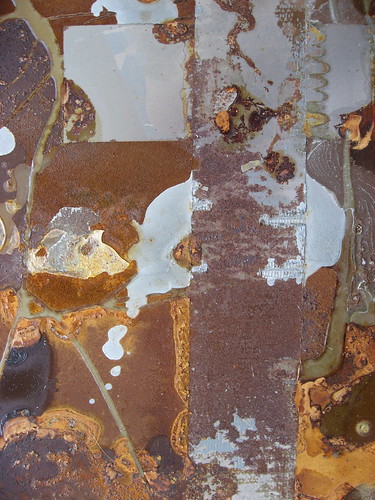
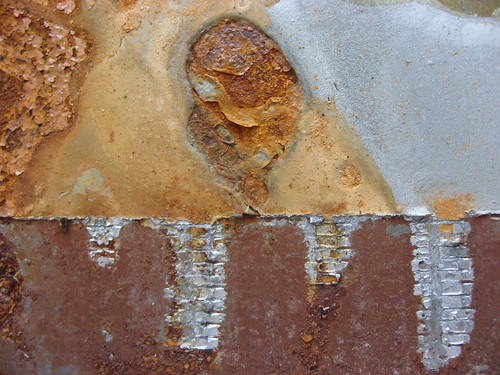
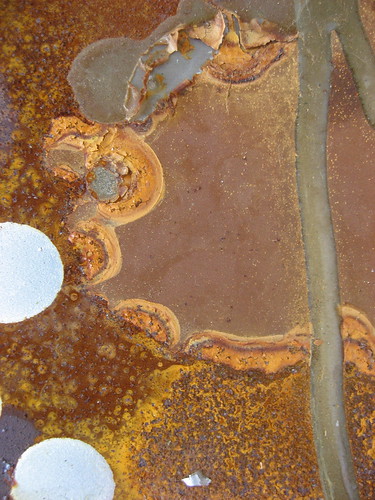
Oxidation can be caused by many things. Oxygen itself pulls electrons off of other substances, oxidizing them. I did a series of art experiments with steel plates that I called "Lust for Rust." I took a plate outside, put some duct tape over it, spilled a little acid here and there, then some polyurethane, some more acid, etc. I left these out for about six months. Here are some of the results:

Random rust

Rust drip

Rust rubble

Gosh I find them attractive. If you'd like to look at some more here is the link:

http://www.flickr.com/photos/22887580@N06/sets/72157617839341570/with/3511417438/

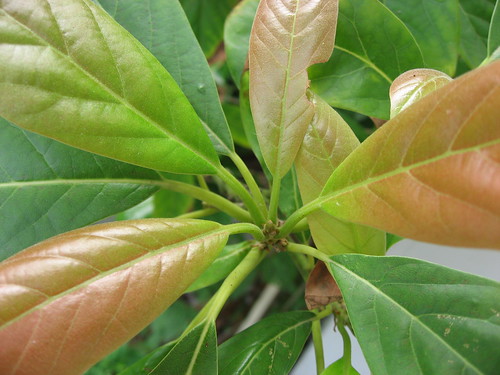
Photosynthesis is a product of oxidation. Chlorophyll is the pigment that initiates the photosynthetic process. When chlorophyll is struck by light of certain wavelengths, it temporarily loses an electron, initiating a cascade of events that harness energy. That energy is used to convert carbon dioxide into sugars, which are essential for the plant's growth. Interestingly, leaves and other photosynthetic organs contain anti-oxidants, which protect the chlorophyll from becoming permanently oxidized due to overexposure to sunlight. The anti-oxidants are the same ones we find in oranges, carrots, and spinach.

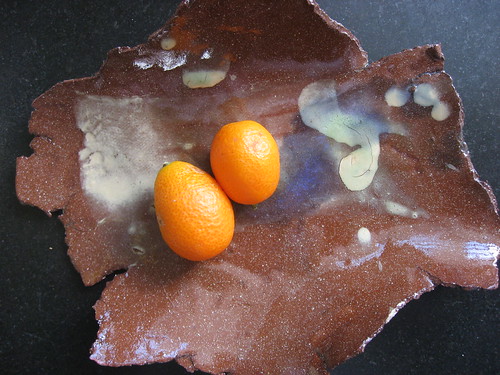
Tile and kumquats

Just as the watercolor in your living room fades, the chlorophyll in a permanently oxidized state would be unable to donate more electrons to the photosynthetic process.

Photosynthesis is such a common process that we take it for granted. To me it's incredibly interesting to think about the link between photosynthesis and Earth history. It's also interesting to think that the process of photosynthesis wasn't really understood until late in the 20th century.

Photosynthesis

Chlorophyll

chloroplast

Everybody knows that plants give off oxygen, which is a by-product of photosynthesis. Photosynthesis did not exist in the Primordial Earth, and it took about a billion years of life for photosynthesis to evolve. Once photosynthetic organisms starting producing oxygen (for several billion years only bacteria did photosynthesis), our planet went from an anaerobic environment (with no free oxygen) to an oxygen-rich environment.

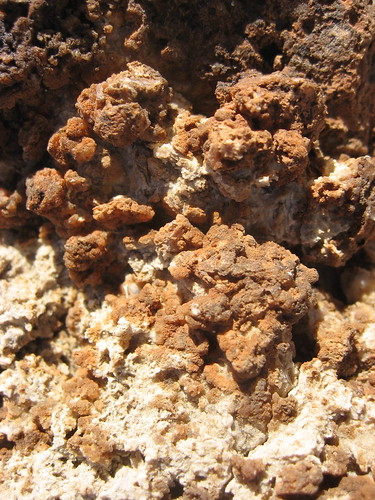
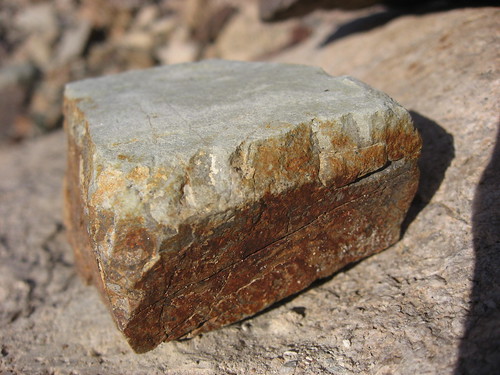
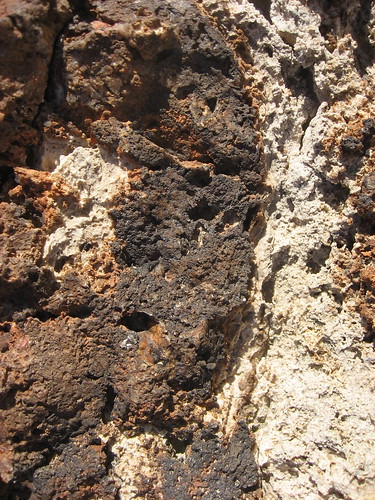
Oxygen first began to accumulate in the vast oceans of our planet, where it was absorbed by rock, most of which was iron-based. Untold deposits of iron oxide (rust) accumulated in the undersea rocks eons ago because of the advent of photosynthesis. Over the ages, many of these rocks were shoved to the surface of the planet. When we take a hike we can see the results of all that Earth history. Here are some pictures I took of natural rust when we were at Death Valley a few years ago.

Iron Oxide Deposits

The Rock Itself

Rust in the Rocks

I guess you can see where I got the inspiration for my series "Lust for Rust."


Saturday, March 3, 2012

The Open Mind, The Internal Library of Images, and Problem Solving

Open Mind and the Internal Library of Images seems like a long title and maybe, of a set of phenomena that aren't related. Or are they?

My rust holder

As a biologist with many years of training and an eye for nature, I have often "prided myself," if you can say that, on the wealth of internal images I have, images that seem to have emerged lately in my ceramic sculpture. My opportunities for seeing have been enhanced partly because of my choice to study organismic biology instead of doing what became a huge fad during my doctoral research time, genomics and phylogeny. So rather than being stuck in a lab, most of my time was spent doing field work. My work in the field attuned me to nature, provided many opportunities for observing landscapes and their details, and gave me a chance to nurture my own feelings for aesthetics.

Milkweed seeds

Huge Erosion

The Shape of Rust

I try to teach my students about "seeing," with limited success I think, maybe because they are still young. And maybe because their minds aren't that open.

What do you do to have an "open mind?" How do you keep the flow of images and impressions coming? I think there are many factors to this.

For one thing, I try to look carefully. Maybe it's part of my training, having to look carefully at microscopic features of living things. And maybe it's just what I like to do. I'll stare at a plant bud or a leaf pattern or a painting for minutes on end.

Flower buds

Maybe part of seeing has to do with looking at a range of things, not just focusing on one class of visuals. So, instead of just looking at flowers I like to look at maps and rocks and shadows and patterns of soap bubbles on the countertop. Sometimes I just delve into flickr and look at what other people are seeing and recording.

Granite and bubbles

Soap on granite

Granite collision

Keeping an open mind may have to do with scanning and responding to your immediate environment. As a bicycle commuter I have to watch closely the traffic, the drivers on their cell phones, car doors, and icy spots. It's not as nice as hanging out in a museum but I guess it does "sharpen the senses."

Public Transportation

What's the point of all this? I guess developing and maintaining visual acuity are connected with inspiration, connecting ideas, recalling images, and feeling the urge to create and innovate. Finally I suppose, this can lead to problem solving. What could be wrong with that?

Friday, March 2, 2012

Using Ash: Accidental Innovation

When I first started looking at clay seriously I was enchanted by the use and appearance of ash glazes. I think of all the glaze techniques they do the most to highlight making clay objects through the process of inferno-like heat.

Ancient Ash

So I asked my friend Nancy Berliner to bring me some ash from her fireplace in New Hampshire. She brought me bagloads and I started using it right away. For a year or so I rolled ash into the terra cotta we used in the lab. I was quite happy with the results, though I fired at a much lower temperature (cone 04-about 1945 degrees F) than I needed. Here are a few examples of my work from that series:

Amorphophallus Model

Merry Tiles All in a Row

Ceramic Tower

Ceramic Shapes

A New Finish

You can see I didn't know what I was doing. It wasn't until I was at the "boot camp" residency at Medalta last year that I came to understand you need a much hotter kiln to melt the ash to get the glaze. Lucky for me I didn't fire these pieces hotter or they would have ruined our electric kiln at BU!

Dark and Light Forms on Rock


Thursday, March 1, 2012

Emergent Properties of the Clay

I applied for a fellowship recently where I wrote, " Does sculpted clay somehow reference itself and its geological origins "in spite of" the artist? How to produce form that references nature without depicting it?"

Floating Shape and Surface

Neolithic Bead Curtain

Tile Closeup

I think these questions bring up the topic of "emergent properties" or "emergent behaviors" of clay that I've been exploring for a long time. Clay as a mineral is formed in certain ways, deposited in certain ways, and manifests itself in the landscape in certain ways.

Clay Colors

Clay

Clay Deposits

When we shape and smooth and sand and glaze our clay pieces, are we somehow overlooking the nature of the clay? It seems to me that some of the most successful pieces, whether they are formal or informal, functional (vessels) or non-functional, recall and celebrate the physical nature of the clay.

Mounted Detail