Monday, May 6, 2013

Landscape Still or Moving?


Experiencing the landscape is a snapshot of the present, a surface at once flat and bumpy, lit and shadowed. Or it is an immersion into an always present moment, a moment that tunnels or ramifies or disappears or endures like an old piece of cloth. In landscape we engage a surface reality, a reality that holds a fascination and motion of its own, a reality that is so "present" it's hard to believe it has a past. Or we see into a past at once murky and clear, designed of its own dreams, elusive, illusion, allusion.


The landscape seems static, unchanging, glacial. It may appear magnificent or insignificant, close or far. Or the landscape is a cascade of movement, starry cold and distant, or the shaded, singing liquid of a waterfall, or warm and smoky with the depth of murky aromas. We see wind in the trees and the grass, we see the movement of cars on the expressway, we see a squirrel busy replanting our garden, and we sense the changing of the day in the movement of light and shadows in our landscapes. But our brains work against us, against what we see. We assume, we almost have to assume, that our landscapes are static. How could we function in landscapes that move, that change, that transform? How could we behave as the instrumental beings we are, or believe ourselves to be, in a landscape lacy with melancholy, neither forged nor knitted, only a wisp of colored smoke?


As part of our cognitive toolbox, as beings that "do" we hold a model of the landscape as something that accommodates us. We act in it or upon it. We are present in its present and we move through it to more presents. Like our planet we know it moves but we perceive the landscape as unmoving. How else can we work in it? The job of landscape is to be still, not to change, to provide a backdrop for our activities. But as a "present" landscape is perforce a moment, temporary and all-quiet, without fabric. Without fabric there is no texture and no time and in a heartbeat we realize the non-concreteness, the non-presence that is evidence of landscape.


Wednesday, April 10, 2013

Seeing What's Real and What's Not

It's strange that I haven't written since early in our trip to Sri Lanka. As the visual cortex got more active later in the trip words were not as readily available. Also, when you consider that connections got more difficult as I got further out of the tourist vortex, or that I had dropped my ipad down the stairs and cracked the screen into a million pieces the first week, you can forgive me for not writing steadily in my blog. 

Oh, that tourist vortex was a strange thing, a kind of thick-walled tube you could see out of only blearily. It took some work to get out of. It's a strange thing that while we were traveling in Sri Lanka, as much as people smiled at us and we smiled back, there were few times when we really understood what was going on around us. Those time were the rare moments when we shared a belly laugh with our hosts about how weird we seemed, large, strangely dressed, sweaty and fairly clumsy creatures. Or when we asked for red rice instead of what tourists supposedly want with their curry (always vegetarian thank you). Or when I started to talk to people in English whether they understood or not, "Stay still, I'll take a picture of your whole family," "Wait, one more!" or when they just let go in Sinhalese or Tamil without any pretense of mutual communication.

Colombo, where we stayed at first, was not exactly western, but it didn't have any of the strangeness we expected. And the experience was repeated in Kandy, where we spent six nights. There we were assaulted by tourists, touts, and traffic and it was hard to draw the goodness that is certainly there out from all the hassle. The crowds were so intense at the Temple of the Tooth Relic there, it was difficult to tell what was a performance (any of it?) as compared to the real thing. The real thing I think, was watching people gather and crowd into spaces to receive blessings, sometimes with tiny babies in tow. No one was putting on a show. It reminded me most of the half day we spent in the Immigration and Emigration Bureau, trying to extend my visa. Crowds, milling about, a kind of sublimated, patient presence. Something like waiting on line for a driver's license here in Massachusetts.

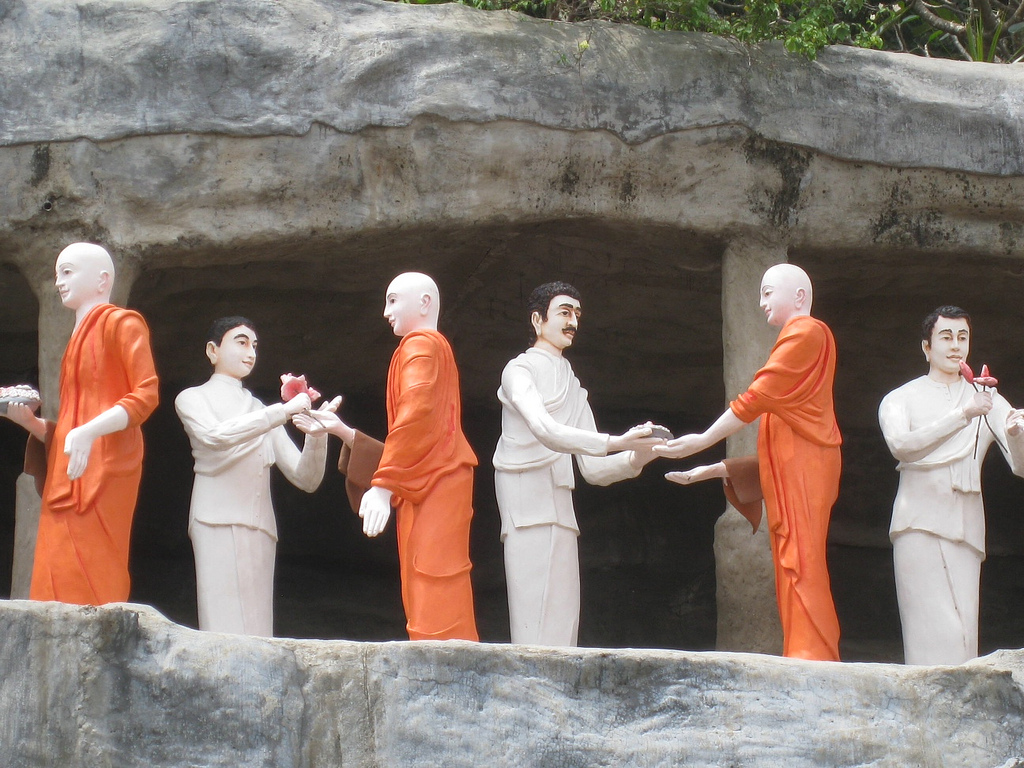
Even during our forays out of town it was hard to tell what was "real." For example, at the Cave Temple of Dambulla and the attached Golden Temple this is what we saw:


Mostly strange depictions of depictions, not very "real" all the way down to the fake caves. Was this what Sri Lanka would be like for us? 

I have to admit I loved the buses, riding and jolting with the regular people, whether I was sitting and holding someone's bag on my lap or acting as their pillow, or being reached across ever so gingerly while someone deposited his betel chew out the window (nice of you to not spit across me!), but Janet not so much. Fair enough. 

But back to Dambulla. I was also fretting there whether I would ever get up close and personal to a wewa, an irrigation tank. From high atop Dambulla I could look out to one or two but they were sunk in the smoky haze and heat of mid afternoon and so was I, I guess. So it was in one of the caves at Dambulla where I had a moment of pure delight, seeing a tank (or a set of tanks) depicted on one of the walls.


There they were, lotuses and all, fed by canals and surrounded by native species of plants and animals, a living iconography that showed me, even if the murals themselves weren't ancient (I think they are 18th century), people were thinking about and valuing these ancient things.

This was a kind of turning point for me after which I went into full gear observing and coming to some kind of understanding about everything that was around. And as it became easier to decode the surroundings it became easier to decode the people, what they were about and maybe what they wanted from me as a fellow human being.

As a scientist I saw some of the depth of the culture around me, sensing its roots in the natural world, sensing some of its origins, connections, and contemporary stresses. As an artist I saw the grace, beauty, and gentleness, yes, even the occasional harshness of a visual environment totally new to me.

Monday, February 4, 2013

After a Long Day Walking in Colombo

Tuk TukColombo TrafficColombo ColorsOld Colombo ApartmentsJeffrey Bawa's TempleLaundry Day at the Monastery
Endangered Slave IslandSlave IslandSlave Island, ColomboDecapitated BuddahBuddah EmanationsPath of Enlightment
A Feel for the DayOn the LakeLake Looks LovelyTreasury of TruthThe Blue RoofPeaceful Shrine
ReflectingColombo's Central ParkMilkBawa's StudioColombo WallTerra Cotta Detsil

We were out in the sun for too long after a delicious but late breakfast. Nothing to drink and swollen feet led to blisters and frustration. But many adventures taking in everything we could, reflected here in a few of the pictures I took.

Sunday, February 3, 2013

Private and Public Life in Colombo

In this busy busy city we spend most of our time on the streets. So we get to have a feeling for the public life that takes place in front of everyone. From that maybe we can guess about the private life people have behind curtains, doors, or walls.

The public life is noisy and out there. Though we see women there are mostly men. Groups of men, men by themselves, men squatting in dirty sarongs, men in uniforms in front of guard posts, men hawking wares, young men walking in groups.

It's the tropics and many of the walls you see are rotting. We looked at housing yesterday that I guess was from the late '40s, about the time of independence. Maybe Soviet-inspired, maybe funded by the USSR. Pretty crowded and decrepit like the streets around them in Slave Island. A block away we saw an elephant in shackles, looking pretty sad, looking like it just tolerated the human being who was following it.

The public street is full of the sounds of horns, beeping, honking, sporadic, steady. And the sound of traffic, wheels careening around curves, trucks and buses jangling in the potholes. Behind the walls there is a kind of quiet, like behind the walls of our house, and family life takes place, women and children, who you don't see many of in downtown colombo. Nut you also see children being taught to beg, dirty children with bare feet, in contrast to the children of our hosts, quiet, obedient, studious.

Somehow the streets we've walked on seem to have less in the way of foods or wares to sell. So the feeling is distinct from Mexico, where it seems the streets are packed with merchandise. We haven't been to the Pettah though, where this kind of action is probably more apparent.

After a night spent mostly awake my mind isn'tworking too well this morning, so I'm not writing up to speed, but here are some good photos from yesterday!


Colombo

Colombo is a city of the developing world. Every ethnicity and religion seems to be here and the evidence is seen in architecture. Hindu and Buddhist temples and shrines, mosques, and churches of every stripe are found around every corner. Buses, trucks, and tuk tuks spew smoke and particulates into the air, and everyone, rushing, is on their horn. That is the noise of the city.

Wide old waterways near the Fort Railway station and every sort of beggar, toothless, eyeless, limbless. Hawkers sell the Sri Lankan flag this weekend, independence weekend. It is hot and humid but there is a breeze. There are sidewalks intermingled with piles of sand and construction materials, ancient braided trees, rotting old concrete buildings.

We have breakfast in a coffee place designed in Southern California with a menu to match, every kind of latte and chai and coffee and tea on tap. A few blocks away the city's main park, a huge modern stadium, old museum buildings, families, and piles of construction materials inside and out. Last night we walked to the ocean as the sun was getting lower and reached a train station right on the water in a blighted part of town, a fire burning right outside an old marketplace, mostly men in sarongs, almost no women, but at one corner a business college filled with hopeful young people who want to be the commercial leaders of this place.

English is compulsory and it seems that all of the supposed 10% of Sri Lankans who speak English are here in colombo. We'll see as we travel farther afield. Hot as it is it seems we can't get enough liquids. The chaotic railway station, flies, fans, sweat, but we got the ticket or almost got the ticket we want for next week, a reserved seat on the Kandy-Badulla line through the mountains. First class and observation car tickets were sold out and the hosts we emailed ahead of time who nicely agreed to help never did.

We are staying on a quiet back street called Barnes place, an old English mansion built about a hundred years ago. The quiet here belies what's outside the gates and a block away, a vibrant, dirty, noisy, living city. We live in the so-called developed world. Subways, sidewalks, a certain crowd control are things we take for granted. Stop here to look at a temple and you attract someone with a sarong who tells you what fierce blue gods are depicted on its walls and asks for money for his storytelling. An elephant in shackles, tuk tuks stopping right in front of you telling you to jump inside, many police giving many tickets.

These few words don't do justice to all we've see in these 24 hours but they are a sampler of the things we've seen and done here in Colombo. Here's a picture of our portico and quiet garden.

Wednesday, January 30, 2013

Water and the Built Environment

Getting ready for an adventurous five-week trip to Sri Lanka where I will focus partially on water.

The island of Sri Lanka, best known for beaches and Buddhas, features a lesser-known geographical phenomenon. Since antiquity, thousands of reservoirs have dotted the landscape. The reservoirs, large man made lakes called wewas, were associated with irrigation, agriculture, and the development of civilizations on the island. These massive public works projects, rebuilt through the ages, are still in use today, often cheek-and-jowl with rice paddies, another landscape feature I hope to explore in detail.

From what I've read, wewas allowed the ancient Lankans to grow two crops a year in their tropical, seasonally dry climate. A relative abundance of food provided the basis for what is today one of the most densely populated countries on Earth. Doubtless the wewas played a role in the development of a governing hierarchy as well as religious and social complexity we see today in Sri Lanka. (I promise to take notes and lots of pictures for future posts. Right now I'm betting that my iPhone5 stays home).

All of this is incredibly cool but the Lankans weren't alone in massive waterworks projects. In other posts I've written about the amazing canals of Xoximilco, south of Mexico City, a paradise of human collaboration with microbes, animals and plants.

Farther north in what is today the Salt River Valley of greater Phoenix, Hohokam peoples developed massive reverse-flow water systems that allowed for three crops a year and supported a population of hundreds of thousands of people. Trade based on Hohokam agriculture spanned thousands of miles and spurred enormous cultural interactions.

One last example. The Nabateans, a poorly known, semi nomadic group who inhabited the Negev Desert in what is today Israel, utilized water catchment techniques that allowed agriculture in one of the world's driest regions. I saw an example this past summer of a similar technique, low tech but highly effective, at the Hopi Second Mesa in Arizona.

Water and water use is such an enormous issue in contemporary society. We depend on vast expenditures to maintain technologies that support human endeavors of every sort. Here in the United States we exert punishing pressure on water resources, emptying ancient aquifers, introducing toxins to our freshwater, and abetting disastrous salinization in freshwater ground tables hundreds of miles from the ocean.

Whether these water management strategies are sustainable will depend on how well they (and we) adapt to future changes and contingencies. As we look to past civilizations we can see that long-term sustainability is never a guarantee in any climate.