Wednesday, February 1, 2012

Strength

Looking at the remains of this leaf I'm reminded of how I teach my students about two super-strong plant molecules, cellulose and lignin. Cellulose is in every plant cell. Per weight it has greater tensile strength than tempered steel. Lignin, which is shown in this picture, is the polymer that gives plants their woody texture. Both cellulose and lignin are practically indigestible. Some fungi and a few bacteria, perhaps a slime mold here and there, are the only organisms with the enzymes to break these babies down.
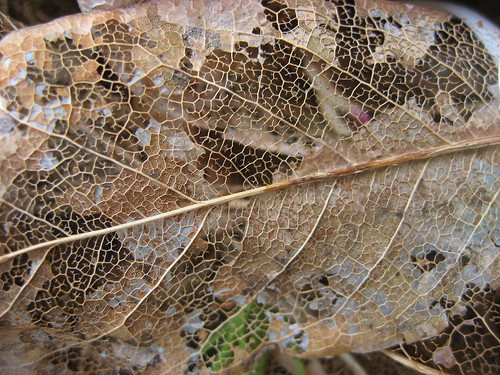
Lignin Leaf Skeleton

What does this have to do with clay? Clay molecules, basically aluminum silicates, are arranged not in polymers like cellulose and lignin, but in sheets of crystalline particles.
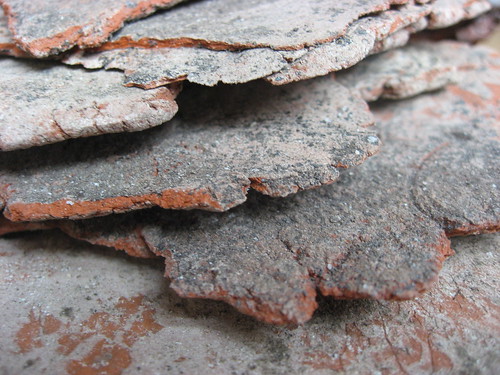
Neolithic Tile Ledge

The clay body by itself is not strong. What amazes me about it is that the clay is suspended in water. Just like soil, even bone-dry clay has water molecules that cling to the clay particles by adhesion, and these aren't driven out until the kiln reaches about 451 degrees Farenheit, the infamous temperature at which paper (and books) burn.

That must be why Liew said, "To see if your salt or soda kiln is cool enough to crack open, put in a piece of paper. If it browns, the kiln is too hot."

That aside, it fascinates me that fired clay is as strong as it is. As I experiment with larger sculptural pieces I'll be interested to see just how far I can push the strength of the clay.
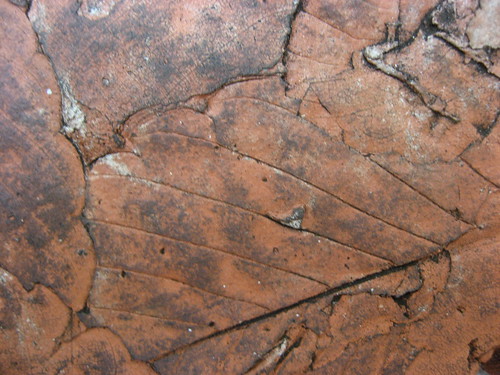
Leaves Overlapping in Terracotta

Monday, January 30, 2012

Finding Flow

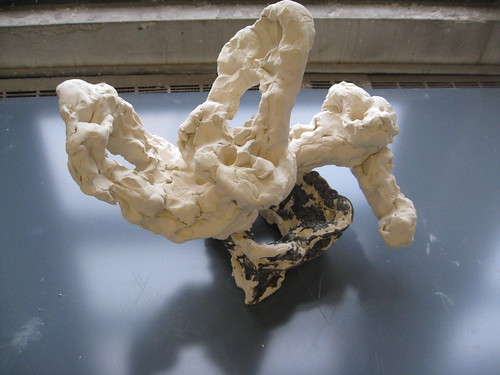
Last Thanksgiving I started this sculpture, which is still a work in progress. A colleague who's a professional sculptor who teaches at BU, was teaching the last class before break. Not many students were there. She asked me to join in the studio that day.

Finding Flow

With clay, there's "throwing" and there's throwing. This sculpture, which I made out of a couple of large pieces of wet clay, was thrown, quickly, curved in my hands, laid on large and small, hard newspaper balls, and put to rest. I think Kitty was surprised at how quickly I worked. At least that's what she remarked to the students.

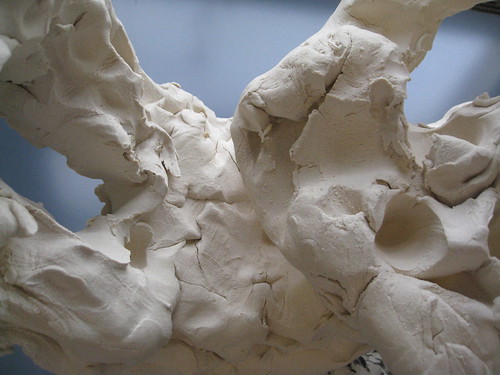
Finding Flow Detail

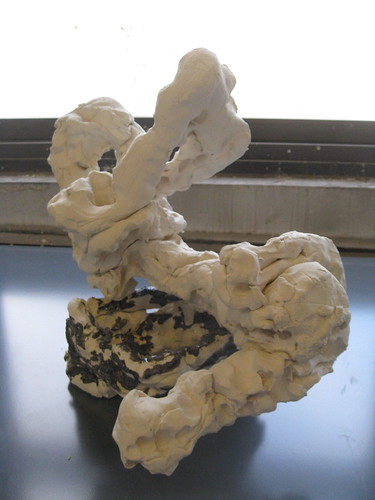
My goal with this and other recent sculptures is to find flow. I want to engage in the clay at a scale that's challenging...almost too large to keep control over...and find a resting point where I'm satisfied with the shape. For me, satisfaction depends on balance, randomness, abstraction, and a state of the clay in which it looks like it might have taken shape naturally. Obviously the piece has to be able to support itself once it's dry and fired.

Finding Flow

In this piece I was experimenting with perforations, which I'd like to explore more. The piece just after it, which I recently published as "Portal to Nature" was itself a large perforation. Lots to work with here, and I'd love to hear your comments.

Saturday, January 28, 2012

Purity

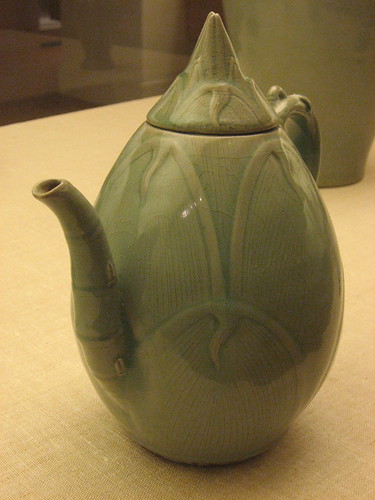
One of my favorite ceramic pieces at the Museum of FIne Arts in Boston is this wonderful 12th century vessel. It was designed to resemble a bamboo shoot.

Bamboo shoot ewer

My attraction to this piece is the skill with which the potter depicted a plant form. It is graceful, beautiful, and it reflects nature.

Later I learned that pieces like this were treasured for their material purity as well their aesthetic beauty. The exquisitely refined materials like porcelain and the celadon glaze used in this Korean piece were unattainable in European craftsmanship until the 18th century.

When I was at Medalta I learned more about porcelain and celadon glaze, materials that are not only pure in their raw state--the best ones are fired at the very highest temperatures for even further refinement. I had a chance to play with porcelain and it was the finest, most luscious material I ever touched.

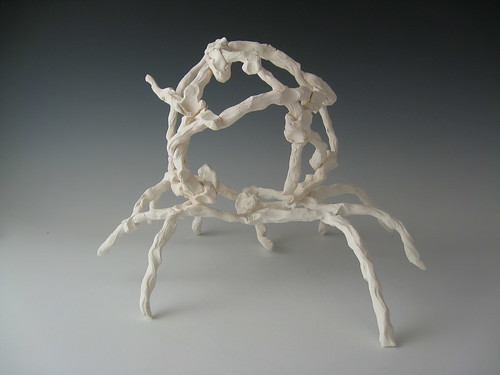
Spider's Dream

Abstract

Two Porcelain Bricks


Material and process are both so important in making art. We think of a finely thrown pot as a highly refined object. But aren't there other types of process in making ceramic art that are just as refined?

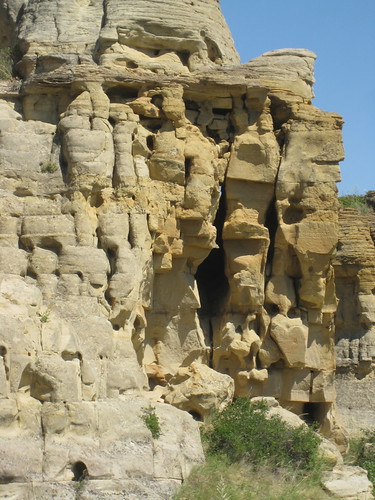
At the end of my time at Medalta Janet came out West and rented a car. Before we went to the Canadian Rockies we spent a few days touring around southern Alberta. Here at Writing-on-the-Wall Provincial Park I had a chance to think about how much my art imitates nature and natural process.

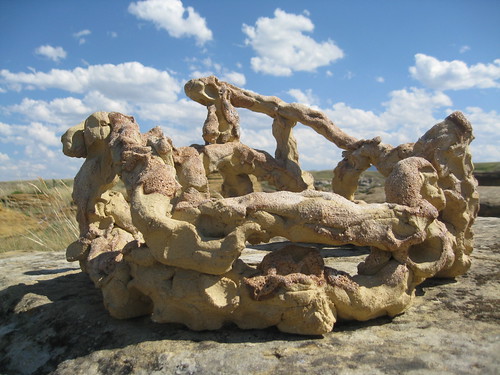
Inspiration Stones

Clay Pose

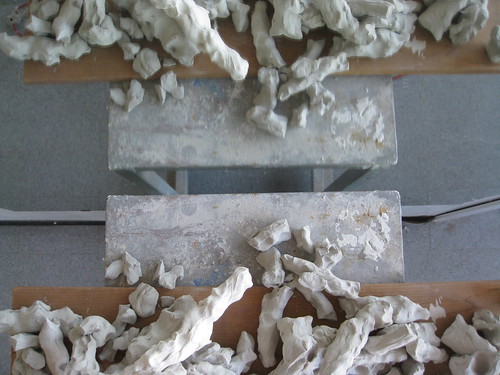
Back in Boston this fall I became preoccupied with clay material and the way it forms itself in patterns that recall its natural origins.

Shard Moment

Failure and Success

Friday, January 27, 2012

Sculpting the Land, Scarring the Land

A few weeks ago I applied for an environmental art residency that asked for a short essay about sculpture and landscape remediation. I've been thinking about that question ever since and woke up this morning with some new ideas about landscape and sculpture.

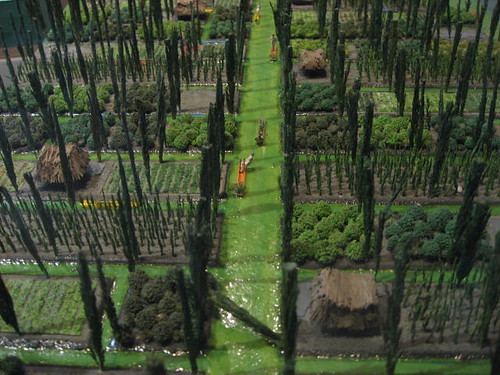
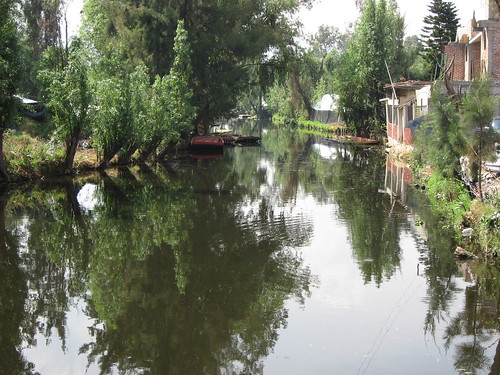
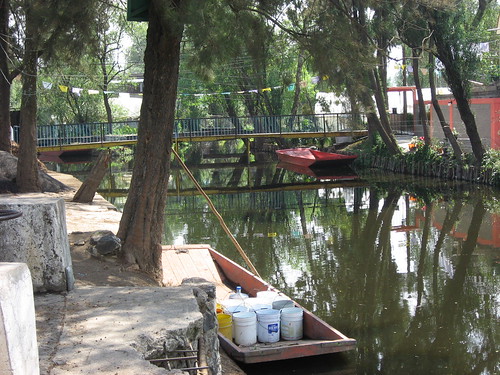
One of the most amazing places I ever visited was Xoximilco, a community at the far south of Mexico City. Xoximilco is at the southern edge of what was once Lake Texcoco, which Mexico City was built on. Since time immemorial the southern part of the lake has been used for a unique style of canal- and island farming, the Chinampas. The pre-Conquest people who lived in this region farmed food crops and flowers on man-made raised beds that they built between canals. Contemporary people continue this tradition.

This enormous floating garden was a true "environmental" sculpture that incorporated human and non-human communities in a long-lived symbiosis. Humans have worked for millenia to replenish the islands and maintain the canals. The Chinampas succeed down to the microscopic level, where photosynthetic bacteria add nutrients to the water and soil, sustaining the system with nitrogen and other nutrients.

Chinampas model

Chinampas

Chinampas, Xoximilco

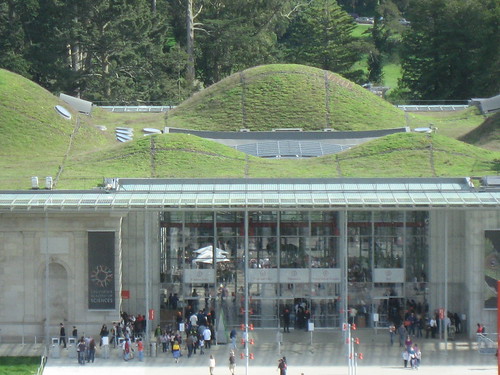
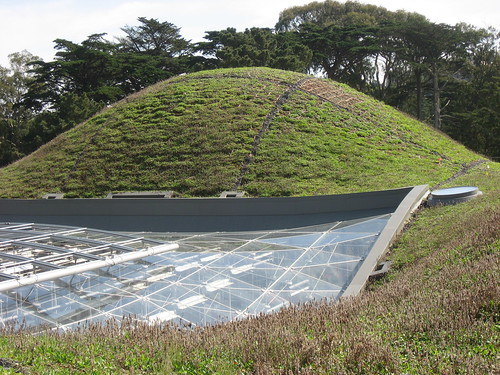
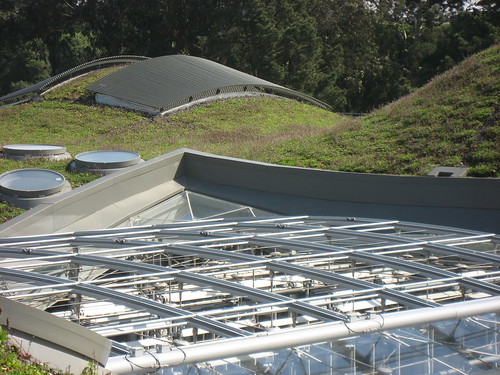
Fast forward to the 21st century. The setting, San Francisco. The sculpture, the roof of the California Academy of Sciences. The cost, hundreds of millions of dollars. The results? The "green roof" at the Cal Academy was an experiment in excess. The plantings didn't work. The drainage system failed. The harsh rooftop environment proved unpredictable in terms of sustaining a plant community that lived up to the specifications of the architects. Aesthetically beautiful as architectural sculpture? I guess. Did it remediate? I don't think so.

And if we think about the level of technology, the capital expenditures, and the scale of the project, it compares poorly to the Chinampas, in both its scale and its performance.

Green Roof at the California Academy of Sciences

Green Roof at the Cal Academy

Green Roof and Skylight at the Cal Academy

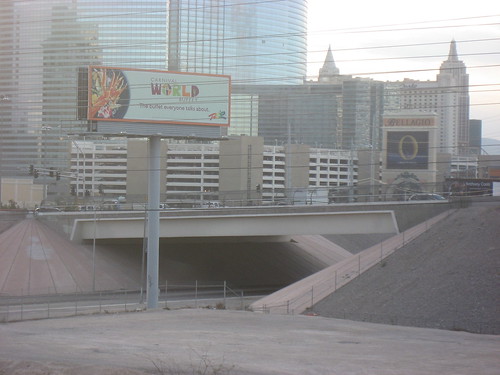
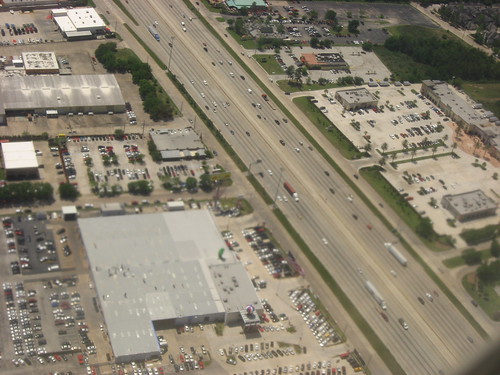
Whether the "green roof" at the Cal Academy "worked" from a biological perspective is one issue. I guess you could say from an aesthetic standpoint it was more of a sculpture and less of a scar. How about this series of land "sculptures?" They are part of a continent-wide effort on a gargantuan national scale that cost billions upon billions of dollars. They "work" to transport people, but at massive costs to the environment and the human community. From any perspective I think they scar, rather than remediate the landscape.

Back View

Bring on the warming

Wasting Energy

Thursday, January 26, 2012

Metacognition

Metacognition--a big word for "looking at what you're doing and understanding why you're doing it." In a way metacognition is thinking about your thinking. I have studied, written, and presented on metacognition, which I think is an interesting approach to engaging students in scientific problem-solving. The idea I've worked up is that scientists, who build models, visualize the natural processes they study. The models are a tool for communicating their ideas to the rest of the world. A couple of weeks ago I compared this with the way artists produce work that represents their way of thinking about the world.


For the past few years I've asked my non-major students to "model" scientific concepts by creating short videos that they post on YouTube. The results are varied. Some students seem to "get it," and their videos reflect time, energy, and thought that they put into the project. Most students seem to make videos that don't reflect much time or energy and the results are disappointing.


I've changed my outlook a bit and I still have students do videos, at least during one semester, but my work in the clay studio has taught me a thing or two.


Students in ceramics are taught to do pinch pots, coils, and slabs. All of these recall the human origins of working with clay. They are the bedrock of traditional ceramic practice and they are thousands upon thousands of years old. Since ceramic work must have started as a way to make vessels, these traditional methods are perforce ways of making pots. Glazing is another technique that is essential to making useful vessels. But are any of these methods necessary to building ceramic sculpture?


I'll get back to that question in a second but it brings me to another, connected thought. Why must science learning involve the orthodoxies that people in high school and college struggle with in order to master biology, chemistry, and physics? Aren't there ways that we can educate people about science without putting them through the paces of classic science practice? Not that these aren't useful, and they certainly are historically important, but are they necessary for a grasp of the processes of nature?


Back to clay. The student results of coiling, slabbing, etc. are very often cutesy cirliqued confections, hearts, squids, flower petals. Then they get glazed and they look like an 8th grader did them. I know students put "time" into them because I see them at work. But the results are something like the unsatisfactory videos many of my students make.


Why don't we train students in a ceramic sculpture class to look long, hard, and deeply at nature before we even have them touch the clay? Similarly, why can't science training be based first and foremost on observation of the natural world? And I don't mean laboratory.


Why this screed on science and art learning? It seems to me we need to encourage a different kind of learning for non-majors. This applies to students like mine who are in their last required science course for the rest of their life. I think it applies as well to students who are in their final semester of college-now finished with their requirements and finally taking an art elective that happens to be ceramics.


We need to let students engage our disciplines at a level by which they can observe their world, take it apart through their own eyes, connect nature with practice, and create work that's both original and mindful. It doesn't matter whether these students can balance an equation or throw a pot because these students may never be scientists or ceramicists. But by leading them through a process of self-conscious observation and practice, albeit informal, we will let them discover their own voice, perhaps leading them to understand why they do what they do. Metacognition.

Wednesday, January 25, 2012

Centering

Yesterday I was talking with my friend Neil Gore about the experience of creating art. I asked him whether he thought there is anyone who doesn't want to make art. This seems like kind of a silly question I guess. There are plenty of people who are not interested at all in sculpture, painting, drawing, printmaking, collage, or for that matter music or literature! 


I asked Janet the same question today. She doesn't make art but she prepares wonderful dishes with grace and simplicity. They are works of art. 


She said there are lots of people who don't want to make art. Then she described half a dozen activities that she seemed to call "not art" like washing and shining your car (we don't have one) until it gleams. Or, as she put it, some people put their energy into house cleaning. I started to think of my years as a field biologist, the time I spent botanizing in nature, my many hours of preparing specimens in my basement lab at Harvard, and how much "centering" or "honing in" was involved in those activities.


So it got me to wondering, if it isn't art, can it still be "art?" In other words, if we look at art as a centering activity, one that commands focus, attention, and calm while providing relaxation and the opportunity to "get out of oneself," can we recognize some kind of relationship between "art" and "non-art"?


I actually had a similar conversation with Lucy the other day when we talked about focusing on a math problem, or a young child focusing on a play activity. The kind of intense, intimate channeling of energy, call it "centering," that is nevertheless totally outside of oneself...is this a similar cognitive space to the one in which art is created?


Maybe there's a way to further break down the question. For one thing, leave the product out of it and focus on the process. So the process of intense focus that makes art or inspires you to polish your car...what is it?


Tuesday, January 24, 2012

Art in Hidden Places

I was preparing a lecture for my students on the hidden places where new species might be discovered. As a botanist I've discovered about two dozen new lichen species, usually in unexpected habitats and often, surprisingly, right in front of my nose. In nature, just about wherever you look is a niche where things grow. You just have to look. For example, this scanning electron micrograph of a moss reveals a lichen (the popcorn ball looking things) growing on top of it, using the moss as a surface to gather a little extra light.


In this picture in I took in the moist uplands of Chiapas State in Mexico numerous species of orchid, spanish moss, and other species, are hanging from a tree branch. Who knows what smaller species, probably microscopic, live in the hanging bundles of epiphytes?


What does this have to do with art?


Before on these pages I've discussed how art is an extension of the human brain and body, a kind of biological extension of the artist. Maybe it's because I've spent so much time in recent months squeezing clay, but it seems to me that art is something that gets squeezed out of the artist, something that lives in and with the artist, something that moves from the hidden recesses of the artist out into the open. Part of the strangeness of art I think is that it comes from such a private place. And at the same time, once the work is finished it is "out there" as an expression of that hidden place it emerged from.


Imagine if all the small critters hidden in the plant bundles on the branch marched out and lined themselves up under a microscope. We would learn something about the habitat, the life cycle, and the evolutionary history of each one. My thought for today: Maybe the work of art reflects a similar set of realities about its maker.


I made this sculpture in the fall. I call it "Olmec Baby's Dog." It's very thick hand-squeezed clay with a pigment and wax finish.