Friday, January 6, 2012

One Month Later

A month after the chicken wire inspiration there’s still a way to go. Ultimately I want to pile these shapes up into an attractive (or repulsive as the case may be) assemblage. For now they’re living on a sumac tree in our front yard. Here are a few shots of this work-in-progress. In spite of certain limitations I’m pleased. I like the way the wire somehow defines the shapes and holds them in conversation. There's a flow to the wire that complements the "stillness" of the ceramic shapes. And I really like the way the chicken wire rolls up at the ends like a croissant.

Wrapped Sculpture

Sculpture in Wire

Clay and Chicken Wire

Thursday, January 5, 2012

Internal Message of the Art


I painted this in my kind of man cave basement studio, a dark place with just a light bulb overhead. As usual when I’m painting I was half blind when I made this. Also as is my wont I tried to do the painting using as little “intention” as I could.

Winter into Spring

The result surprised me because it looks so much like some of the sculptures I was doing this summer.

Hand in the Clay

The painting took a couple of weeks. I like the way it turned out. The details are striking and tell a story of their own.

Sprouts Detail

Pink Detail

Winter into Spring Detail

What’s the internal message of art? Why do some images come back again and again to us? I think the message is “I’m here beside you.”

Wednesday, January 4, 2012

An Art Problem


I’m asking you have a little fun and give me a bit of a crit. Here’s the background:
A few weeks ago I went to the retrospective deKooning exhibit at MOMA. As a very young man in my twenties I took in deKooning’s work and made an art philosophy of my own from it, something you might call “absolute abstract.” Nothing should depict anything. I’ve done a lot of art since then, and seeing the show was poignant for me because at least one of the commentator/curators articulated what had become my own art concept. So this leads me to the question: How much should art tell a story?
As my clay work unfolds I have just the lingering feeling that maybe I’m not telling enough of a “story” with my art. It’s so abstract that it reminds people of anything they want to see in it. But would it be “stronger” if it were slightly more tilted toward the figurative?
So here is a short series of pieces. Each pair is made of the same material, the same pieces, arranged in different ways. Which member of each pair works best? Why? Does it matter? I’d love to hear your opinion.
Mean Mask
Prairie Mask Deconstructed


Teacher and Students
Discussing the Chair


Night Window Treatment
Neolithic Ceramics Obhects

Tuesday, January 3, 2012

Plunging and Emerging

So, scientist plunges into art. A bellyflop? A warm embrace? And emerges….an “emergent artist?” Looking at these sprouting seeds reminds me that the pathway of emergence in plants is complex--a process that includes finely tuned responses to the environment, highly choreographed communication within the seed, and a well regulated release of nutrients. It’s a sort of mobilization that has evolved over the eons to permit survival of the species when they are in a state of particular vulnerability, germination.

Wheat sprouts: Resource mobilization

Can we compare the “emerging” artist to a germinating seed? Is it something delicate, complicated, and sensitive to the environment or is it a living force that, once begun, moves forward inexorably?

Wheat Country

Monday, January 2, 2012

Is it Real? Do We Care?


A glorious ostrich fern grows in a shady part of my garden and I caught this picture of it on a nice day last summer. I love the unexpected pattern that emerges at the horizontal, as your eye traces the space from the bottom up.

At some level the pattern reflects the internal structure of the plant, which includes the water-carrying xylem tissue.

Prehistoric heart


Months later I reconstructed this sculpture, originally meant to reference the pillars at Ake, Yucatan and renamed it “Xylem.” I’m not sure why. It certainly doesn’t represent any xylem structure I know.


Sunday, January 1, 2012

Science and Art Reconsidered

As a botanist my primary interest has always been taxonomy. What makes it a pine? A fern? A monocot? Not to bore you with what interests me…it’s visual, it’s mildly philosophical, it’s fun, but I guess not rocket science. Before I started on the botany path Janet and I were living in Alaska.
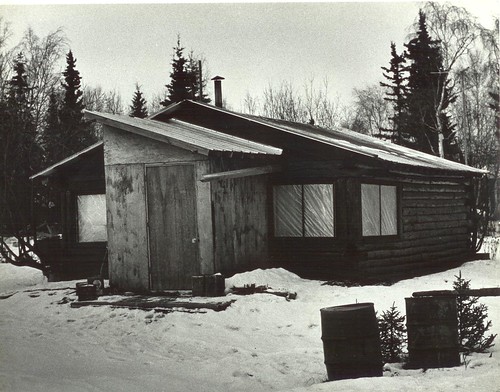
Our Log Cabin


McGuire's Tavern


With the Red Wagon


I became enchanted with the natural world there, picked up Eric Hulten’s circumboreal flora, and started memorizing every plant.


Denali National Park


Soon I was on the way to San Francisco State University where I took the dreaded science requirements and started my work toward a Master’s Degree in biology.

Meandering Stream, McGrath, AK


A series of meanders had me studying taxonomy and eventually I made my way to Harvard, where I finished a doctoral dissertation on a large and difficult group of lichens, the Cladoniaceae, of western North America.

Cladonia cervicornis

Studying these fascinating beasts occupied fully my intellect, a welcome challenge with all the free time I had raising three children.

About the time I was finishing my dissertation the scientific wags were full swing into deconstructing Linnean taxonomy. You may remember Linneaus as the 18th century “father of botany,” one of whose achievements was the bimomial nomenclature (genus and species) we use for all species. Why the urge to deconstruct? It was one of the fads, I mean, modes of study of the late 20th century. More to the point I think, Linneaus lived 100 years before Darwin and perforce could not have classified his living world within an evolutionary framework. The long and short of it…the whole classification system had to be restructured to reflect phylogenetic relationships, actual physical kinship among living species.

Not a bad goal, one that attracted funding and jobs for scientists, but perhaps a goal that might have overlooked other equally valid streams of scientific thought. Couldn’t scientists just mutually agree that Linnean taxonomic groups weren’t clearly related and move on? I guess I wasn’t heardheaded enough, got enamored of morphology and morphogenesis, and headed down my own particular stream of thought.

So, what’s the connection with art?

Several years into teaching at Boston University I had the opportunity to develop and teach a series of courses in London.

Modules

The Screamer in a Sextet

Urban oasis

Between classes I spent my share of time in places like Tate Britain, where as an undergraduate I had experienced some time with the paintings of JWT Turner.

Revisiting Turner as a scientist led me to an interesting question. What did Turner understand about nature that his contemporary, Linneaus, was perhaps unaware of?

Putting it another way, how can we compare two revolutionaries, an artist and a scientist, and the way they shaped Enlightenment thought?

Fast forward to the last decade of the 20th century and we see Linneaus’ work repudiated. For better or for worse, his system of classification was based on Platonic (ideal, unchanging) and Aristotelian (hierarchical) concepts that were disproven by Darwin (whose work is still too hot to handle in our time!). By contrast, look at Turner’s work. His depictions of light and movement challenge us still. Having transcended artistic conventions of his time, Turner created work that continues to transcend.

How about our roles as artists or scientists in 2012? Both disciplines are incredibly diverse in our time and perhaps all barriers have been broken. Are there conventions we can still challenge? How do we move forward toward the light? Can we forge new directions by considering the history of both art and science in reflection with one another? What’s your opinion about the Linneaus/Turner comparison?

Flexibility

I just finished a couple of thoughts on flexibility in my other blog "Botany Without Borders: Where Design Meets Science"

http://botanywithoutborders.blogspot.com/

Looking at plants for all these years I've come to appreciate the many ways in which these "sessile" organisms move. In a broad sense they flow with their immediate environment, whether it's the internal movement of water, their interactions with moving air around them, the search for nutrients, or in the broadest sense, evolutionary changes in response to selective pressures, isolation, and random changes in the gene pool.

Wood growth


Bittersweet double helix

Viviparous leaves

This led me to wonder: How can we make our approach to art more flexible? How can we respond to our environment, our material, our vision?

Ceramic Towers

Radioactive Flower Detail

And how can we refine our art vision to achieve greater engagement with the world around us, whether at the intimate level where our hands touch the clay or from a broader perspective, where our work forms a presence in the great world that's out there, way outside of us and our studio.

My Sculptures at Red Rock Canyon

My Fence Installation

My Signature

Happy and Healthy 2012!